
For most buyers, the POLESTAR Electric Trailer Jack is the best jack for camper trailer because its powered lift reduces the effort needed to hitch, level, and disconnect a loaded trailer. Its electric operation makes routine setup easier than cranking by hand, especially when the trailer sits on uneven ground. The design suits owners who want practical assistance without a complicated setup.
This guide is for camper owners replacing a manual jack or adding powered support to a trailer. Focus on lift capacity, mounting fit, build materials, and power needs, since a jack must support the trailer safely and fit its frame. The five picks below are ranked by their best use cases, with clear reasons and honest drawbacks for each. That makes it easier to match a jack to your trailer size, towing routine, and budget.
Quick Comparison
| # | Product | Best For | Price | |
|---|---|---|---|---|
| 1 | POLESTAR Electric Trailer Jack | Powered tongue lifting | ~$181 | View → |
| 2 | Kohree RV Stabilizer Leveling Scissor Jacks | Manual RV stabilization | ~$70 | View → |
| 3 | LIBRA 9K Scissor Jacks | Heavy-duty trailer leveling | ~$149 | View → |
| 4 | Kohree 7500lb Electric Trailer Jack | Electric high-capacity hitching | ~$180 | View → |
| 5 | OULEME RV Camper Scissor Jack | Compact camper support | ~$69 | View → |
5 Top Camper Trailer Jacks
The list is ranked by lifting capacity, stability, and ease of use, counting down to the top camper trailer jack.
5. OULEME RV Camper Scissor Jack
Best for: RV owners needing stable campsite leveling
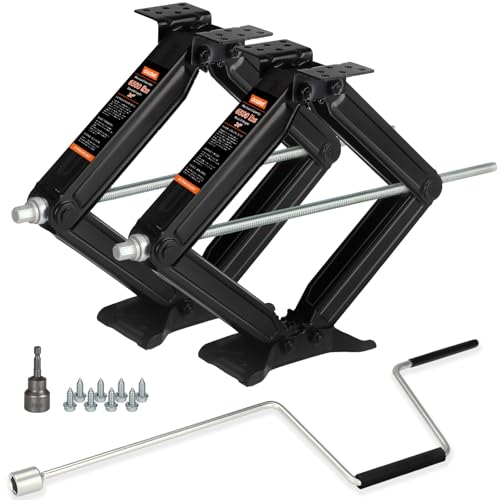
The OULEME 6500 lbs RV Camper Scissor Jack comes as a two-piece stabilizer set for trailers and recreational vehicles. Each jack adjusts from 4 inches to 24 inches, helping support different frame heights during setup. The pair is listed with a 6,500-pound lifting capacity, though buyers should confirm how that rating applies to their trailer and setup. An extra-wide base plate helps spread the load on firm ground.
This kit includes a manual crank handle, a 3/4-inch drill socket, eight 3/8-inch mounting screws, and an instruction manual. The included socket can speed up adjustments if you already own a compatible drill. The jacks measure 26 inches long, 5 inches wide, and 4 inches high when retracted, while the maximum working height reaches 24 inches. Chromate-plated bolts use a salt-spray-tested coating for added resistance to rust. At around $69, the set offers useful equipment for owners who need built-in trailer support without buying parts separately.
Pros
- 4- to 24-inch adjustment range fits many trailer frame heights.
- Wide base plates provide better support on suitable, level ground.
- Includes the crank, drill socket, screws, and instructions.
Cons
- The 26-inch retracted length may require careful storage planning.
- Scissor jacks are for leveling and stabilizing, not replacing proper wheel chocks or supporting a moving trailer.
4. Kohree 7500lb Electric Trailer Jack

Best for: RV owners who want powered hitching
The Kohree 7500lbs Electric Trailer Jack is made for RVs, campers, and travel trailers that need easier hitching and leveling. Its motor lifts up to 7,500 pounds, with a 22-inch range for trailers of different heights. A press-button control handles raising and lowering, while the built-in top level helps with basic positioning. The price is around $180, though it can change.
Several details add practical value. The bright LED light supports setup during early mornings or after dark. A manual crank handle provides backup if the electric function is unavailable. The weather-resistant cover helps shield the jack from rain and dust, and overload protection adds a safety measure during operation. The dual-wire design connects directly to the trailer, which can support dependable power but requires access to the correct wiring. Kohree includes one year of manufacturer service.
Pros
- 7,500-pound lifting capacity suits many RVs, campers, and travel trailers.
- 22-inch travel and a built-in level simplify hitching and leveling.
- LED light and manual crank support nighttime or backup use.
Cons
- Direct dual-wire installation may require basic wiring work.
- The 7,500-pound rating refers to lifting capacity, not automatic support for every trailer size.
3. LIBRA 9K Scissor Jacks
Best for: RV owners needing four fixed stabilizers
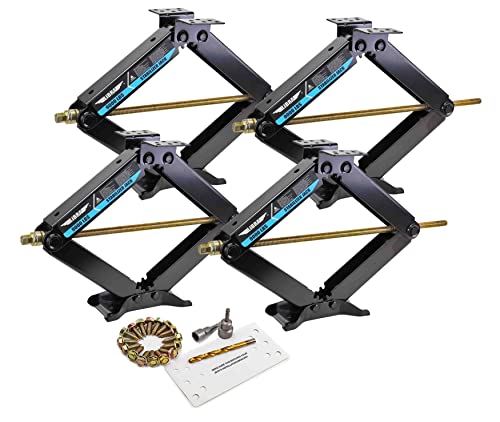
The LIBRA set includes four steel scissor jacks for RVs, campers, and trailers. Each jack adjusts from 5 inches closed to 24 inches extended, with a 26-inch retracted length and 7.5-inch width. The frames use thick 11-gauge steel with an electrophoresis coating, which should help resist wear and corrosion. The listed 9,000-pound capacity applies to stabilization, not lifting a trailer off the ground.
This kit includes a 3/4-inch magnetic hex socket for power-drill use, plus 16 mounting screws, a matching 9/16-inch socket, an 11/36-inch drill bit, and a drilling-guide sticker. That hardware reduces the need to gather parts before installation. Around $149, it costs more than basic two-jack kits, but it covers all four corners. The jacks can help reduce trailer movement at camp, though installation requires drilling and a suitable mounting location. Use them only after the trailer is properly supported and leveled with approved equipment.
Pros
- Four jacks provide stabilization at each corner instead of requiring separate purchases.
- The 5-to-24-inch adjustment range fits trailers with different frame heights.
- The included magnetic socket supports faster power-drill operation.
Cons
- These jacks are not for lifting, tire changes, or carrying vehicle weight.
- Permanent installation requires drilling into the trailer frame or mounting structure.
2. Kohree RV Stabilizer Leveling Scissor Jacks

Best for: Travel trailer owners needing extra stability
The Kohree 7500-pound RV scissor jack set includes two steel stabilizers for trailers, campers, motorhomes, and pop-ups. Each jack reaches 24 inches at full extension and retracts to 4 inches high. Its retracted length is 26 inches, with a 7.3-inch width. The electrophoresis-coated steel should resist surface wear better than untreated metal, though long-term exposure still depends on storage and maintenance.
A crank handle lets you raise or lower the jacks by hand. The included drill bit also supports faster setup with a compatible power drill, but the drill itself is not included. Smooth-tooth gears guide the arms through a straight vertical motion, while the wide bow-tie bases help spread contact with the ground. Around $70 for two jacks, this set offers useful coverage for owners who need a pair rather than a single replacement. These are stabilizers, not a substitute for a proper lifting jack when changing tires or supporting a trailer during major service.
Pros
- Two 24-inch stabilizers provide support at both ends or sides of a trailer.
- Heavy-duty steel construction and electrophoresis coating add resistance to wear.
- Hand crank and included drill bit give you two setup options.
Cons
- A compatible power drill is required for faster operation and is not included.
- The package lists the jacks and tools, but not mounting hardware, so compatibility should be checked before purchase.
1. POLESTAR Electric Trailer Jack
Best for: Heavy A-frame trailers
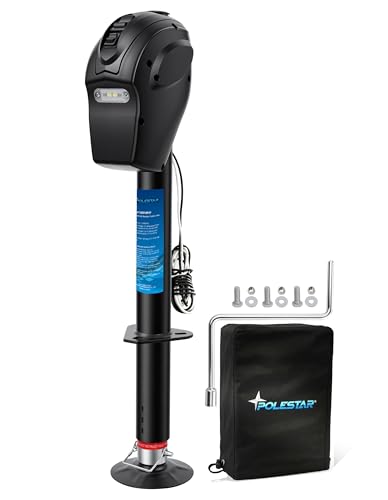
The POLESTAR Electric Trailer Jack is a powered A-frame tongue jack for trailers, RVs, boats, and off-road haulers. It carries a manufacturer-rated 5,000-pound dynamic load and offers up to 7,500 pounds of static lifting power. The jack retracts to 9 inches and extends to 27 inches. Its 4.5-inch drop leg increases the maximum height to 31.5 inches, giving it useful range on uneven ground or sloped parking areas.
A ball screw mechanism works with the brake motor to provide controlled raising and lowering. That design should also reduce friction compared with a basic screw jack. Weather-resistant construction helps it handle outdoor storage, while the included rain cover adds protection around the motor and controls. Built-in LEDs shine onto the coupler and hitch ball at night. A circuit breaker trips and resets if current becomes too high. At around $181, it costs more than a manual tongue jack, but the powered operation can save effort when connecting or positioning a heavy trailer. It still needs a suitable trailer power connection, and installation may require basic wiring work.
Pros
- 5,000-pound dynamic capacity suits many heavy trailers.
- 9-to-27-inch travel, plus a 4.5-inch drop leg, adds setup flexibility.
- LED work lights improve visibility around the coupler after dark.
Cons
- Electric operation depends on a working trailer battery and proper wiring.
- The 7,500-pound rating applies to static lifting, while the dynamic rating is 5,000 pounds.
Buying Guide
Load capacity is the most important factor when choosing a trailer jack. A jack rated below the trailer’s loaded tongue weight can bend, stall, or fail during hitching.
- Weight rating: Find the trailer’s loaded tongue weight, then choose a jack rated at least 1.5 times higher. A 2,000-pound rating suits a 1,300-pound tongue load.
- Lift range: Compare the jack’s retracted and extended heights with the trailer coupler. Look for at least 10 inches of usable travel, plus 2 inches of clearance for uneven ground.
- Mounting style: A-frame trailers commonly use bolt-on or weld-on jacks, while some campers need a side-mount model. Check the frame width, bolt pattern, and available space before buying.
- Power source: Manual tongue jacks cost about $40 to $100 and work without batteries. Electric models often cost $150 to $400, but require a 12-volt connection and weather protection.
- Base and durability: Choose a 5- to 9-inch footplate or a compatible wheel for soft ground. For coastal or wet regions, galvanized steel or a corrosion-resistant finish can reduce rust.
If you cannot have everything, prioritize the correct load rating, then confirm the lift range fits your hitch height.
Frequently Asked Questions
How do I choose a jack for my camper trailer?
Choose a jack rated above your trailer’s loaded tongue weight and sized for its mounting area. A 2,000-pound side-wind jack suits many small campers, while heavier trailers may need 3,500 pounds or more. Check clearance, lift range, wheel or footplate design, and whether the coupler height matches your hitch.
What size jack do I need for a camper trailer?
You need a jack with a rated capacity greater than the trailer’s fully loaded tongue weight. For example, a 3,500-pound jack provides a useful margin for a 2,500-pound tongue load. Measure the trailer frame, mounting hole pattern, and required lift before choosing a pipe, swivel, or electric model.
Can I use a regular trailer jack on a camper?
Yes, you can use a standard trailer jack on a camper if its capacity, mounting hardware, and lift range fit the trailer. A 2,000-pound unit may work for a lightweight camper, but a loaded tongue above that rating requires a stronger model. Confirm bolt sizes and frame clearance first.
Are electric jacks better than manual camper jacks?
Electric jacks are better for frequent setup or heavy tongue weights, while manual jacks cost less and remain usable without battery power. A powered model can lift with a switch, but it needs a charged 12-volt system and weather protection. Manual options often make more sense for campers under 2,000 pounds.
Conclusion
POLESTAR Electric Trailer Jack is the top pick for camper owners who want powered tongue lifting and less hand cranking at setup. If your priority is the lowest purchase cost or a simple backup that works without a battery connection, choose a manual trailer jack instead. Before buying, double-check the jack’s size, mounting compatibility, required quantity, and current price for your trailer. Also confirm that the unit matches your trailer’s tongue design and intended load, since a poor fit can create mounting problems or limit safe use. An electric model makes the most sense for frequent camping, larger trailers, or anyone who finds repeated cranking uncomfortable. For occasional trips, a basic manual option may provide better value.

