
The BOTE EasyRider Aero SUP/Kayak Hybrid is the best inflatable sup kayak hybrid for most buyers because its convertible design supports both stand-up paddling and seated touring. One boat offers two useful setups, which suits casual lake trips, fishing, and short coastal outings without separate gear.
This guide is for shoppers who want portable paddlecraft for lakes, calm bays, and weekend travel. Start with deck size and construction material, since they shape stability, durability, packed weight, and setup demands. A model that fits your car trunk is easier to use often. Seat support and included accessories matter for longer outings, too. The five picks below are ranked with reasons and honest drawbacks for each, so you can compare options before buying.
Quick Comparison
| # | Product | Best For | Price | |
|---|---|---|---|---|
| 1 | BOTE EasyRider Aero SUP/Kayak Hybrid | Casual lake paddlers | ~$639 | View → |
| 2 | BOTE Lowrider Aero Inflatable SUP Kayak Hybrid | Anglers needing lower seating | ~$1039 | View → |
| 3 | BOTE Lowrider Aero SUP Kayak Hybrid | Compact-water touring enthusiasts | ~$799 | View → |
| 4 | ISLE Switch 3.0 Inflatable Hybrid Kayak Paddle Board | Families wanting convertible paddling | ~$635 | View → |
| 5 | WAVESTORM 9ft6 SUP Kayak Hybrid | Budget-conscious recreational paddlers | ~$565 | View → |
5 Top Inflatable SUP-Kayak Hybrids
These picks are ranked by stability, setup, tracking, and value, counting down to the top inflatable paddleboard-kayak hybrid.
5. WAVESTORM 9ft6 SUP Kayak Hybrid

Best for: Casual family lake outings
The WAVESTORM 9-foot-6 hybrid paddleboard is a soft-top SUP designed for adults and kids across different skill levels. Its length gives paddlers a useful balance of standing room and manageable handling for calm lakes, bays, and slow-moving water. The foam construction also makes the deck less intimidating than a hard fiberglass board, especially for younger users who may fall while learning. At around $565, it sits in a higher price range for a soft-top board, so buyers should have a clear plan for regular use.
Its core uses EPS foam, and three internal stringers add structure through the board. The WBS, or Water Barrier Skin, covers the top deck and adds a layer between the rider and the foam surface. That combination is the main point of interest here. It provides a soft deck with more internal support than a basic foam board, while the 9-foot-6 shape can suit a broad range of paddlers. Still, this is a general-purpose platform, not a compact travel board or a racing SUP. The listing identifies it as a kayak hybrid, but the available details do not confirm a seat, paddle, or other kayak accessories.
Pros
- EPS foam creates a softer deck for adults and children.
- Three stringers add internal support to the board.
- The 9-foot-6 length offers useful standing space.
Cons
- Its nearly 10-foot length may require extra storage and transport space.
- The listed details do not confirm included kayak accessories.
4. ISLE Switch 3.0 Inflatable Hybrid Kayak Paddle Board
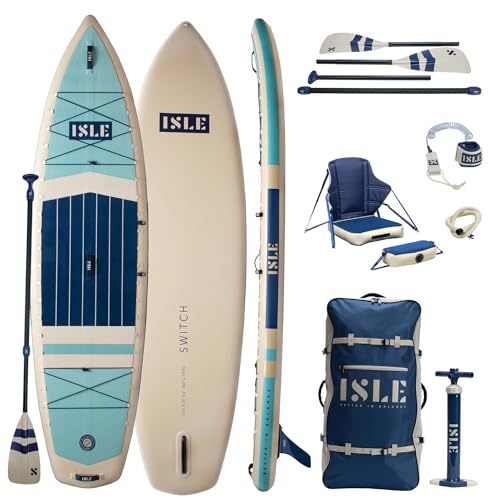
Best for: Families wanting one adaptable watercraft
The ISLE Switch 3.0 combines an inflatable stand-up paddle board with a kayak setup. It measures 11.6 feet long, 35.5 inches wide, and 6 inches thick. The 17-pound hull uses Air-Tech Fusion Lite fabric, while the inflated board weighs about 23 pounds. Its broad shape should provide useful stability for paddling, kneeling, or standing.
The ISLE-LINK system uses webbing loops and stainless steel G-hooks to attach the seat, foot brace, or other accessories. You can configure it for solo or tandem kayak use, then switch back to a SUP without buying a second craft. The bundle includes a high-back seat, padded foot brace, four-piece carbon adjustable paddle, spare blade, hand pump, backpack, and touring fin. At around $635, it costs more than basic inflatable SUPs. The listed capacity also needs attention: product details cite both 425 and 475 pounds, so confirm the current limit before purchase.
Pros
- One board supports SUP, solo kayak, and tandem configurations.
- Full-length traction padding supports standing, kneeling, pets, and lounging.
- The package includes the seat, pump, paddle, fin, and carry bag.
Cons
- The 425-to-475-pound capacity discrepancy makes load planning less clear.
- A 17-pound hull and 23-pound inflated weight are manageable, but the packed kit still requires storage space and carrying effort.
3. BOTE Lowrider Aero SUP Kayak Hybrid

Best for: Casual paddlers who want two setups
The BOTE LowRider Aero 10’6″ is an inflatable watercraft that works as both a stand-up paddle board and a kayak. Its 10’6″ platform offers a stable base for cruising, fishing, exploring, and relaxed recreational paddling. Removable kayak seats let you switch from standing to seated travel, while the included hybrid paddles support both styles. At around $799, it costs more than many basic inflatable boards, but it includes equipment that reduces the need for separate purchases.
Its strongest feature is the flexible setup. You can paddle from above the deck, then add a seat when you want back support or a lower center of gravity. The board also supports BOTE Rac System accessories, MAGNEPOD attachments, and dedicated KULA Cooler tie-downs. Those connection points give anglers and day trippers more ways to carry supplies. Since it inflates and packs down, this hybrid avoids the roof rack or trailer required by many rigid kayaks and paddle boards. The trade-off is that you must handle setup, packing, and storage after each outing.
Pros
- Combines standing and seated paddling in one 10’6″ platform.
- Includes removable kayak seats and hybrid paddles.
- Accessory points support Rac System gear, MAGNEPOD items, and KULA Cooler tie-downs.
Cons
- Inflation and pack-down add preparation before and after each trip.
- The hybrid format may feel less specialized than a dedicated kayak or touring paddle board.
2. BOTE Lowrider Aero Inflatable SUP Kayak Hybrid

Best for: Tandem lake and bay paddling
The BOTE LowRider Aero 11’6″ is an inflatable SUP and kayak hybrid for solo outings or shared paddling. Its 11-foot-6-inch platform gives two people more room than a compact board, with space for extra equipment on longer lake, river, bay, or coastal trips. Around $1,039, it costs more than many basic inflatable SUPs, but the package covers more than the board alone.
Two removable kayak seats let you switch from standing to seated paddling. The included hybrid paddles support both setups, so you do not need separate SUP and kayak equipment. BOTE’s Rac System compatibility adds options for mounting accessories, while MAGNEPOD points and KULA Cooler tie-downs help organize drinks or small gear. Since it packs down after deflation, transport and storage are easier than with a rigid tandem craft. The 11’6″ length still needs a larger setup area, and the total load should match the maker’s stated limits.
Pros
- Supports solo or tandem use on one 11’6″ platform.
- Includes two removable kayak seats and hybrid paddles.
- Rac System, MAGNEPOD, and KULA Cooler mounts add gear flexibility.
Cons
- Around $1,039, it costs more than basic inflatable SUPs.
- Inflation takes extra setup time, and the material needs protection from sharp surfaces.
1. BOTE EasyRider Aero SUP/Kayak Hybrid

Best for: Casual lake and bay paddlers
The BOTE EasyRider Aero 10’4″ combines a stand-up paddle board with a sit-down kayak setup. Its inflatable build packs into a travel bag, making storage and car transport easier than with a rigid board. On the water, you can paddle standing up or attach the removable kayak seat for a lower, more relaxed position. The included hybrid paddle supports both configurations, so you do not need to buy a separate paddle right away.
Stability is the main appeal here. The 10’4″ platform gives new paddlers a steady base for calm lakes, rivers, bays, and short weekend outings. It is also sized for recreational use without becoming a full-size touring craft. MAGNEPOD attachment points support compatible accessories, while Travelink compatibility can help with carrying gear. At around $639, this is a sizable purchase, but the two-in-one setup adds value for households that want both paddling styles. Its limits are clear, too. It is built for relaxed adventures, not fast open-water trips or technical kayak touring.
Pros
- Converts from a stand-up board to a seated kayak with the included removable seat.
- Includes one hybrid paddle for both SUP and kayak positioning.
- Inflatable design fits into a travel bag and supports easier storage.
Cons
- Inflation, deflation, and drying add setup time before and after each outing.
- The hybrid layout will not match a dedicated touring kayak or rigid SUP for speed and efficiency.
Buying Guide
The most important factor is usable stability, which depends on the board’s width and weight rating. Choose a craft 32 to 36 inches wide, rated for at least 30 pounds more than the combined rider and gear.
- Width and capacity: Look for a 10 to 12-foot hull with a 32 to 36-inch beam and a 300-pound minimum capacity for one adult.
- Construction: Drop-stitch PVC floors provide firmer support than basic air chambers. Choose reinforced seams and at least 6-inch-thick side tubes.
- Kayak conversion: The package should include a padded seat, adjustable backrest, footrest, and at least two attachment points. A double-bladed paddle is useful for seated travel.
- Portability: Aim for a packed weight below 35 pounds and a carry bag with backpack straps. A hand pump with a pressure gauge should come in the box.
- Water use and safety: A removable tracking fin helps on lakes and calm coastal water. Add a leash, personal flotation device, repair kit, and pressure range printed on the valve or manual.
- Price and warranty: Expect to pay $300 to $800 for a complete setup. A one-year warranty is a reasonable minimum, while longer coverage adds purchase protection.
If you cannot have everything, prioritize width and weight capacity because stability affects comfort and safety most.
Frequently Asked Questions
How does an inflatable SUP kayak hybrid work?
An inflatable SUP kayak hybrid works as a stand-up paddleboard with a removable or adjustable seat and kayak-style paddle. You can paddle standing in calm water, then attach the seat for lower, more stable seating. Most models use drop-stitch PVC construction and measure about 10 to 12 feet long.
What size inflatable paddleboard kayak is best for beginners?
A 10- to 12-foot inflatable paddleboard kayak is usually the most practical beginner size. Look for a width of 32 to 36 inches, which provides useful balance without making the board hard to carry. A 10-foot model suits one smaller paddler, while a 12-foot version offers more glide and room.
Can inflatable SUP kayak hybrids handle rivers?
Inflatable SUP kayak hybrids can handle slow, gentle rivers, but they are not ideal for whitewater or rocky rapids. Choose a model with reinforced PVC, several air chambers, and a removable fin. Keep pressure within the manufacturer’s range, often around 12 to 15 PSI, and wear a properly fitted PFD.
Are inflatable SUP kayak combos easy to transport?
Inflatable SUP kayak combos are generally easier to transport than hard boards because they pack into a carry bag. Many weigh roughly 25 to 40 pounds and fit in a car trunk once deflated. You still need space for the pump, paddle, seat, fin, and drying time before storage.
Conclusion
The BOTE EasyRider Aero SUP/Kayak Hybrid remains the top pick for casual paddlers who want one inflatable craft for calm lakes, slow rivers, and relaxed shoreline trips. If your priority is lighter carrying weight or a lower purchase price, choose a compact, lighter model instead, because portability and cost may matter more than extra deck space. Before buying, double-check the packed and inflated size, included seat and paddle compatibility, accessory quantity, and current price, because listings can change. Also consider storage and transport: a 10-foot-plus board needs room at home, while a compact car may require a roof-free carrying plan. A hybrid is most useful when its setup fits your routine.

