
For most buyers, the FO-KOKO Dual Hose Portable Tent Air Conditioner & Heater is the best air conditioner for a tent because it combines cooling and heating in one portable unit. Its dual-hose design also makes it a practical choice for enclosed camping spaces, especially when nighttime temperatures change. That year-round flexibility makes it the strongest starting point for this list.
This guide is for campers who need more control than a fan can provide. The most important factors are the unit’s size, power draw, hose setup, and cooling coverage. A compact model may fit smaller tents, while a larger one can need more electrical capacity and ventilation space. The five picks below are ranked with clear reasons and honest drawbacks for each.
Quick Comparison
| # | Product | Best For | Price | |
|---|---|---|---|---|
| 1 | FO-KOKO Dual Hose Portable Tent Air Conditioner & Heater | Cold-weather tent campers | ~$450 | View → |
| 2 | Outohome Portable Camping Air Conditioner | Off-grid summer campers | ~$370 | View → |
| 3 | BAYKUL Portable Camping Air Conditioner & Heater | Four-season campsite travelers | ~$460 | View → |
| 4 | Cybertake S2 Pro Portable Camping Air Conditioner | Compact shelter sleepers | ~$779 | View → |
| 5 | 5-in-1 Portable Mini Air Conditioner | Budget-conscious small-room users | ~$30 | View → |
5 Top Tent Air Conditioner Picks
These portable coolers are ranked by cooling practicality, packability, and tent comfort, counting down to our top pick.
5. 5-in-1 Portable Mini Air Conditioner

Best for: Small personal cooling zones
This compact evaporative cooler combines a fan, mist maker, humidifier, night light, and rechargeable power source. Its 800 mL water tank supports mist output, while three reusable ice crystal boxes can provide colder airflow after freezing. The unit weighs about 2 pounds, so it can move from a desk to a bedside table, tent, RV, or car.
Control comes through a smartphone app, with three fan speeds and three mist levels for different comfort needs. A 2,000 mAh battery provides up to 12 hours of cordless use, although runtime will depend on the selected settings. USB power works with a laptop, power bank, wall adapter, desktop computer, or vehicle charger. At around $30, it offers more functions than a basic USB fan. Still, this is personal cooling, not a replacement for a full-size air conditioner. It cools nearby air rather than an entire room.
Pros
- Three reusable ice boxes can make the airflow cooler than water alone.
- App control adjusts fan speed, mist, lighting, and operating modes.
- Rechargeable 2,000 mAh battery supports cordless use for up to 12 hours.
Cons
- Evaporative cooling works best in dry conditions and has limited reach.
- The 800 mL tank needs refilling, while mist may add unwanted humidity in damp rooms.
4. Cybertake S2 Pro Portable Camping Air Conditioner
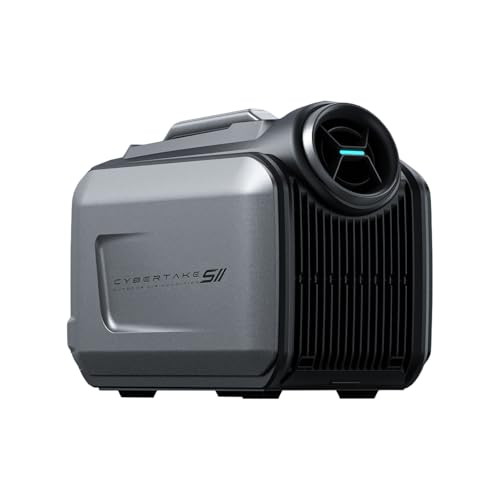
Best for: Small tent campers needing heat
The Cybertake S2 Pro is a portable compressor air conditioner and heater for tents, RVs, cabins, and spaces up to 130 square feet. It delivers 5,100 BTU of cooling and 6,100 BTU of heat, with temperature settings from 60°F to 90°F. Four modes cover cooling, heating, dehumidifying, and lower-power Eco+. In Eco+, the maker rates power use at 1kWh for up to eight hours.
Its biggest advantage is flexible power. You can use a 100V-240V wall outlet, a 12V or 24V vehicle connection, or 48V DC from a portable power station. A boost converter is sold separately. The included hoses and adapters support setup in about 30 seconds, though cooling may take 5-10 minutes to stabilize after startup. Three fan speeds, a 0-12-hour timer, and waterproof silicone buttons add useful control. The IPX4 shell handles splashes, while the listed 40dB noise level should suit nighttime use. Around $779, it costs more than basic tent fans. The remote control is also separate.
Pros
- Cools and heats spaces up to 130 square feet.
- Supports wall, vehicle, and 48V DC power.
- Eco+ mode may run for up to eight hours on 1kWh.
Cons
- A separate boost converter is required for some 48V DC setups.
- The remote is extra, and operation is limited to 41°F-113°F ambient temperatures.
3. BAYKUL Portable Camping Air Conditioner & Heater

Best for: Buyers needing one portable unit
The BAYKUL is presented as a portable camping air conditioner and heater with a 6-in-1 design. Its main appeal is the dual cool-and-heat setup, which could make one appliance useful across warm and cold trips. The listing places it around $460, so buyers should expect more than a basic fan or small space heater.
The available feature information creates a serious question, though. It also describes “1 case of 24 packs” and “24 count total,” wording that does not clearly match a single portable climate-control unit. No cooling capacity, heating output, battery size, runtime, dimensions, weight, or noise rating appears in the supplied details. Those missing figures make it hard to judge tent suitability, vehicle use, or storage needs. Confirm the package contents and operating requirements with the seller before paying the premium price.
Pros
- Combines cooling and heating functions in one listed product.
- A 6-in-1 design may cover more than one camping need.
- Portable construction is intended for use away from home.
Cons
- The “24 packs” and “24 count total” details conflict with a single air conditioner and heater.
- Missing output, runtime, size, and power specifications make performance difficult to assess.
2. Outohome Portable Camping Air Conditioner

Best for: Tent campers with portable power
The Outohome portable air conditioner is a 5,200-BTU cooling unit for tents, RVs, vans, trucks, and small rooms. It measures 22.4 by 11.2 by 13.8 inches and weighs 31 pounds, so one person can move it using the built-in handle. Its metallic spray finish gives the case a more polished look than many basic camping appliances. The listed price is around $370, though pricing can change.
A GMCC compressor supports cooling from 60°F to 88°F. The manufacturer claims it can reduce ambient temperature by 18°F within five minutes under suitable conditions, but tent insulation, outside heat, and power supply will affect results. Four modes cover cooling, fan, sleep, and dehumidifying. Sleep mode runs at 46 to 50 dB, while a remote and 24-hour timer add convenience. Power use is rated below 400 watts. Cooling usually needs no drainage below 70% humidity, but wetter conditions require the included drain hose.
Pros
- 5,200 BTUs provide stronger cooling than small personal fans.
- Four operating modes suit hot, damp, or cooler nights.
- Compact 31-pound design fits many tents, RVs, and vans.
Cons
- At 31 pounds, it is portable but not light for long walks.
- High humidity requires drainage, and outdoor use needs a suitable power source.
1. FO-KOKO Dual Hose Portable Tent Air Conditioner & Heater

Best for: Tent campers with portable power
FO-KOKO is a 34-pound portable air conditioner and heater for tents, RVs, vans, garages, and small rooms. It provides 6,800 BTU of cooling and 7,500 BTU of heating, with a temperature range from 60°F to 86°F. Its dual-hose setup separates intake and exhaust airflow, which can help remove heat faster than single-hose designs. The company claims cooling speeds up to 50% faster and efficiency gains above 20%, though results will depend on enclosure size, outdoor temperature, and available power.
Five modes cover cooling, heating, drying, fan-only operation, and sleep. Sleep mode is rated at 45dB, while the touch controls and remote let you change temperature, fan speed, and mode from across the tent. The unit works from 110V outlets, power stations rated above 1,500 watts, or an EV’s V2L outlet. Adapters are sold separately. A carry bag, ducts, and standard adapters come included. At around $450, it costs more than basic portable coolers but adds heating for three-season use.
Pros
- Dual hoses can remove heat more effectively in enclosed tents.
- Heating, cooling, drying, fan, and sleep modes cover multiple seasons.
- Included carry bag and ducts simplify transport and setup.
Cons
- It needs a strong power source, and EV or power-station adapters cost extra.
- The 34-pound body plus two ducts takes space and is not light for hiking.
Buying Guide
The most important factor is the power source. A tent has limited electricity, so an air conditioner must match your campsite outlet, battery, or generator without shutting down overnight.
- Cooling method: Choose a compressor AC for real temperature reduction. Evaporative coolers work best in dry air and need ventilation, while portable AC units require a hose and sealed opening.
- Cooling capacity: For a small, enclosed sleeping tent, look for roughly 5,000 to 8,000 BTU. Large tents lose cooled air quickly, so even that range may struggle without a partition.
- Power demand: Check running watts, not only startup watts. A unit drawing 500 to 1,000 watts usually needs shore power or a generator, since a 1,000Wh battery may last about one to two hours.
- Size and weight: Favor models under 25 inches tall and 50 pounds for car camping. Smaller units are easier to store but often cool less space.
- Noise and drainage: Look for a rated noise level near 55 dB or lower. Confirm whether the unit needs continuous drainage, a water tank, or a hose connection.
If you cannot have everything, prioritize power compatibility, since an efficient cooler is useless without a dependable energy source.
Frequently Asked Questions
How do you cool a tent without a power hookup?
A battery-powered portable cooler can cool a small tent without a wall outlet, but its runtime depends on battery capacity and outside temperature. A compact evaporative model may run 6 to 12 hours from a charged power station, while compressor-based units often need more energy and may last only 2 to 5 hours.
What size air conditioner works for a tent?
A 5,000 to 8,000 BTU portable air conditioner is generally suitable for a small, enclosed tent, provided the unit has enough electrical power. Tent size, sunlight, insulation, and occupancy affect the load. For example, a two-person tent in direct afternoon sun may need more cooling than a shaded shelter of the same floor area.
Can you use a regular portable AC in a tent?
Yes, you can use a regular portable AC in a tent, but it needs a reliable power source and a safe way to exhaust hot air. Most household models draw substantial electricity, so check generator output before camping. An 8,000 BTU unit may require roughly 900 to 1,200 running watts, depending on its design.
Are evaporative coolers good for camping tents?
Evaporative coolers are a good choice for dry, ventilated campsites, but they work poorly in humid conditions. These units use water and airflow rather than a compressor, so they consume less electricity. Expect useful cooling when humidity stays below about 50 percent, while damp coastal weather can leave the tent feeling warmer.
Conclusion
FO-KOKO Dual Hose Portable Tent Air Conditioner & Heater remains the top pick for campers who want one compact unit that can cool a tent in warm weather and provide heat during chilly nights. If your priority is lower weight, simpler setup, or less gear to carry, choose a smaller cooling-only portable unit instead, since a heater and dual-hose design may add bulk, power demands, and setup work. Before buying, double-check the unit’s dimensions, hose and window-vent compatibility, the quantity needed for your tent or group, and the current price, since campsite layouts, tent sizes, and seasonal discounts can change the practical value of any climate-control option.

