
The FO-KOKO Dual Hose Portable Air Conditioner & Heater is the best air conditioner for tent camping for most buyers. Its main advantage is versatility: one unit can cool warm spaces and heat them on cold nights, while the dual-hose design supports better air exchange than a single-hose layout.
This guide is for campers who need more than a fan inside a tent, cabin, camper, or other small shelter. Focus first on the unit’s size and weight, since transport and floor space matter at camp. Power draw and coverage matter just as much, especially with a generator, battery station, or campground hookup. Hose placement, noise, and setup also affect comfort. The 6 picks below are ranked with clear reasons and honest drawbacks for each, so you can match the machine to your shelter, power source, and trip length.
Quick Comparison
| # | Product | Best For | Price | |
|---|---|---|---|---|
| 1 | FO-KOKO Dual Hose Portable Air Conditioner & Heater | Dual-Season RV Campers | ~$450 | View → |
| 2 | Outohome Portable Camping Air Conditioner | Summer Tent Sleepers | ~$370 | View → |
| 3 | BAYKUL Portable Camping Air Conditioner & Heater | Cold-Weather Campers | ~$460 | View → |
| 4 | Portable Camping Air Conditioner | Budget-Conscious Outdoor Travelers | ~$490 | View → |
| 5 | Portable Tent Air Conditioner | Small Tent Occupants | ~$370 | View → |
| 6 | FO-KOKO 5200 BTU Portable Camping Air Conditioner | High-Heat Tent Campers | ~$300 | View → |
6 Top Air Conditioners for Tents
This ranked list counts down through six tent-friendly air conditioners, starting with solid options and ending with the strongest overall pick.
6. FO-KOKO 5200 BTU Portable Camping Air Conditioner

Best for: Cooling small tents, vans, and RVs
The FO-KOKO portable air conditioner is a compact, windowless cooling unit for spaces up to 130 square feet. It measures 12.8 by 10.6 by 22.8 inches and includes a carry handle, so it can fit in a tent, van, truck, RV, garage, or small indoor room. The unit can also operate inside its carry bag, which may simplify outdoor setup and storage. Around $300, it costs more than a basic evaporative cooler but provides compressor-based cooling.
Its 5,200 BTU output runs on 400 watts and offers a 60°F to 88°F temperature range. FO-KOKO claims the unit can lower room temperature by 18°F in five minutes, though actual results will depend on insulation, starting temperature, and humidity. A dual-loop water system cools the condenser, while the 75-degree auto-swing vent spreads airflow vertically. Cooling, dry, sleep, and fan modes cover different conditions, and the 24-hour timer helps limit runtime. Sleep mode reaches 45 dB. Drain-free use applies below 70% humidity, but adapters for power stations or EV V2L use cost extra.
Pros
- 400-watt operation works with 110V outlets and 1,500-watt-plus power stations.
- Compact 12.8-by-10.6-by-22.8-inch body fits many tight camping setups.
- Four modes, a 24-hour timer, and 45 dB sleep operation support overnight use.
Cons
- Cooling performance can drop in hot, humid spaces or poorly insulated tents.
- Separate power adapters add cost for off-grid or EV-based operation.
5. Portable Tent Air Conditioner
Best for: Tent campers needing portable cooling
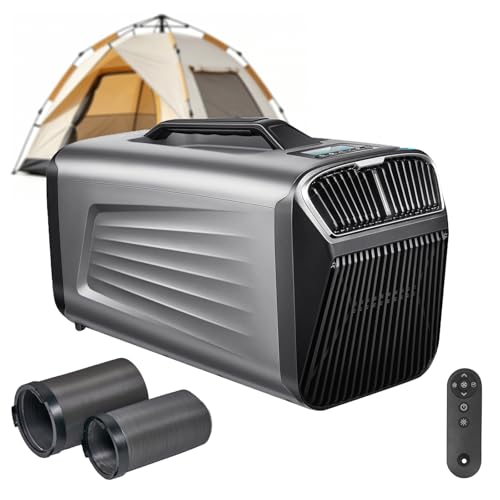
This compact air conditioner is built for spaces that cannot use a window or wall unit. It measures 22.4 by 11.2 by 13.8 inches and weighs 31 pounds, with a grip for one-handed carrying. That size fits many tents, vans, RVs, semi trucks, kitchens, and small apartments. The listed price is around $370, so it costs more than a basic fan or evaporative cooler.
A GMCC compressor provides 5,200 BTU of cooling, with a claimed 10°C, or 18°F, temperature drop in five minutes. Set the target from 60°F to 88°F. Power use stays below 400 watts, which helps at campsites with limited electricity. Cooling, fan, dehumidifying, and sleep modes cover different conditions. A remote and 24-hour timer add convenience. Below 70% humidity, the unit does not need a drain hose. In wetter conditions, the included pipe removes water. Sleep mode is rated at 46 to 50 dB, quiet enough for many sleepers, but not silent.
Pros
- 5,200 BTU output suits tents, RVs, vans, and small rooms.
- Four modes, a remote, and a 24-hour timer improve control.
- Drain-free operation works below 70% humidity.
Cons
- At 31 pounds, it is portable but not especially light for backpack-style camping.
- The around-$370 price is high compared with fans and evaporative coolers.
4. Portable Camping Air Conditioner

Best for: Tent campers without shore power
This 7500 BTU portable air conditioner targets tents, RVs, vans, and other compact spaces. It measures 21.38 by 12.4 by 14.29 inches and weighs 34 pounds, so one person can carry it. Its four operating modes cover cooling, drying, sleeping, and fan use, while a timer adds scheduling control. The remote lets you adjust settings from across a tent or vehicle.
Cooling settings range from 60°F to 86°F, with rated power below 570 watts. The unit claims to lower temperatures within five minutes, though results will depend on insulation, outdoor heat, and the space size. Sleep mode produces 58 dB of noise, which is quieter than full-speed operation but still audible at night. Automatic dehumidifying avoids draining below 70% humidity. Above that level, you need the included matching drain hose. A double-sided electrostatic coating helps resist scratches. At around $490, this is a specialized comfort upgrade rather than a low-cost fan replacement.
Pros
- 34-pound weight and compact dimensions suit road trips, tents, and RV storage.
- Four modes, a timer, and remote control provide flexible operation.
- Under-570-watt rated power may reduce energy use compared with larger portable units.
Cons
- The 58 dB sleep rating may still disturb light sleepers.
- High humidity requires a drain hose and a suitable place for water discharge.
3. BAYKUL Portable Camping Air Conditioner & Heater

Best for: Buyers needing bulk product quantities
The BAYKUL listing presents this item as a portable camping air conditioner and heater with six functions and dual cooling and heating. However, the available feature information only confirms “1 case of 24 packs” and 24 total count. It does not provide dimensions, weight, battery details, power input, cooling output, heating range, noise level, or runtime. Those missing details matter for camping use, where space and power limits can quickly affect comfort.
The clearest advantage is the quantity. A 24-count case could suit group trips, rental cabins, event supplies, or buyers stocking multiple locations. It may also reduce the need to place repeated orders. Still, the listing does not explain what each pack contains or how the 24-count relates to the portable warmer and cooler. At around $460, the purchase needs careful verification before checkout. Confirm the exact package contents, electrical requirements, and return policy. Without those details, the product’s six-function claim is difficult to assess against similar portable climate-control units.
Pros
- A 24-count case provides enough units for group or multi-location use.
- The portable format may suit camping setups with limited floor space.
- Dual cooling and heating could cover two seasonal needs in one purchase.
Cons
- The listing omits key specifications, including size, weight, runtime, and power requirements.
- The 24-pack format may be excessive for one camper or a small household.
2. Outohome Portable Camping Air Conditioner

Best for: Tent campers needing spot cooling
The Outohome Portable Camping Air Conditioner is a compact compressor-based unit rated at 5,200 BTU. It measures 22.4 by 11.2 by 13.8 inches and weighs 31 pounds, so one person can move it with the built-in handle. Its metallic spray finish gives the case a more durable feel than lightweight plastic designs. At around $370, it costs less than many full-size portable air conditioners, but far more than a basic fan.
Outohome claims the unit can reduce room temperature by up to 18°F within five minutes under suitable conditions. The thermostat covers 60°F to 88°F, and four modes include cooling, fan, sleep, and dehumidifying. A remote and 24-hour timer add useful control inside a tent, van, RV, or small room. Power draw stays below 400 watts, though actual use depends on temperature and compressor cycles. Cooling usually needs no draining below 70% humidity. In wetter conditions, the included drain hose becomes necessary. Sleep-mode noise is listed at 46 to 50 decibels.
Pros
- 5,200 BTU output suits tents, vans, RVs, and small rooms.
- Four modes, remote control, and a 24-hour timer improve convenience.
- Built-in dehumidifying helps during damp weather.
Cons
- At 31 pounds, it is portable but not especially light for long walks.
- Cooling claims depend on conditions, and high humidity may require manual draining.
1. FO-KOKO Dual Hose Portable Air Conditioner & Heater

Best for: Tent campers with portable power stations
FO-KOKO is a compact portable air conditioner and heater for tents, RVs, vans, garages, and small rooms. It provides 6,800 BTU of cooling and 7,500 BTU of heating, with Cool, Heat, Dry, Fan, and Sleep modes. The temperature range runs from 60°F to 86°F. Its dual-hose setup is designed to remove heat more effectively than single-hose units, while the 34-pound body and included carry bag make transport manageable.
This unit stands out for flexible power options. It works with standard 110V outlets, 1,500W-plus power stations, and EV V2L systems, although separate adapters may be needed. The manufacturer lists cooling in 30 seconds and heating in 60 seconds, but actual performance will depend on tent size, insulation, and outdoor temperature. Sleep mode is rated at 45 dB, and users can control settings from the touch panel or remote. At around $450, it costs more than basic portable fans and small coolers, but it combines cooling and heating in one package.
Pros
- Dual hoses can improve heat removal in enclosed tents and vehicles.
- Five operating modes provide cooling, heating, drying, fan-only, and sleep settings.
- The 34-pound design includes a carry bag and supports several power sources.
Cons
- Separate adapters may be required for power stations or EV V2L use.
- A 1,500W-plus power source limits use with smaller battery packs.
Buying Guide
Most important factor is available electrical power. A portable air conditioner may need 500 to 1,200 watts, so a small battery could last less than two hours and leave you without cooling at night.
- Power source: Match the unit to your campsite. Shore power is simplest, while a 1,000-watt inverter generator or battery power station may support smaller models. Check startup wattage, not only running wattage.
- Cooling capacity: For a single-person tent under 100 square feet, look near 2,000 to 5,000 BTU. Larger tents, direct sun, and two sleepers may need more, but extra capacity also raises power use.
- Ventilation: Choose a model with a flexible exhaust hose and a window or door panel. Measure the opening first, and allow about 6 inches behind the unit for airflow.
- Runtime and noise: Seek at least 4 hours of rated battery runtime, if battery-powered. A sleeping-area unit should list noise near 55 decibels or lower.
- Packability and cost: Compare weight, hose storage, and footprint. A 20- to 40-pound unit and a $250 to $700 price range are common targets, but verify current specs.
If you cannot satisfy every requirement, prioritize power compatibility, since an efficient cooler is useless without a suitable energy source.
Frequently Asked Questions
How can I cool a tent without hookups?
The most practical option is a portable evaporative cooler or low-watt camping air conditioner powered by a large battery station. True compressor units usually need shore power or a generator. A 500- to 1,000-watt-hour power station may run a small cooler for several hours, but runtime depends on cooling mode and outdoor heat.
What size air conditioner do I need for a tent?
For a small, enclosed tent, a 5,000-BTU unit is usually the practical starting point, if the manufacturer allows that setup. Larger family tents need more airflow, but extra capacity also raises power use. Measure the tent first, seal gaps, and confirm the unit can run safely from your campsite’s outlet or generator.
Can I run an air conditioner in a tent safely?
You can run a tent air conditioner safely only when it is designed for camping use and connected to a properly rated outdoor power source. Keep generators at least 20 feet from the tent, never use fuel-burning equipment inside, and protect plugs from rain. Follow clearance, grounding, and ventilation instructions exactly.
Are portable air conditioners worth it for tent camping?
Portable air conditioners are worth it for tent camping only when you have reliable electricity, enough ventilation, and a suitable tent opening for the exhaust hose. Otherwise, an evaporative cooler or battery fan costs less to run. A 20- to 50-watt fan uses far less power than many compressor-based units.
Conclusion
The FO-KOKO Dual Hose Portable Air Conditioner & Heater is the top pick for campers who want cooling and heating from one portable unit and have enough tent space for its setup. If low weight and simple overnight use matter more than true air conditioning, pick a compact evaporative cooler instead, since it uses less power and packs more easily. Before buying, double-check the unit’s size, tent and power compatibility, included quantity, and current price, since listings can change. Plan the hose route before your trip, too. A suitable vent opening and stable power source matter as much as cooling capacity. The right choice balances comfort, packed size, setup time, and campsite power limits.

