
The CEVING Mini Manual Coffee Grinder is the best camping coffee grinder for most buyers because its hand-powered design needs no battery or outlet. Its small format suits camp kitchens, storage bins, and short trips, while manual grinding keeps the setup simple. It is a practical choice for making fresh grounds away from home.
This guide is for campers, hikers, van travelers, and anyone building a compact coffee kit. The key factors are packed size, grinder materials, grind adjustment, and how much coffee the chamber can hold per batch. Those details affect storage, durability, brewing options, and morning workload. The six picks below are ranked with clear reasons and honest drawbacks for each, so you can match a grinder to your routine and available space.
Quick Comparison
| # | Product | Best For | Price | |
|---|---|---|---|---|
| 1 | CEVING Mini Manual Coffee Grinder | Travelers needing compact grinding | ~$18 | View → |
| 2 | Tierra Trazza Manual Coffee Grinder | Budget-minded home coffee brewers | ~$47 | View → |
| 3 | JavaPresse Manual Coffee Grinder | Beginners learning manual grinding | ~$25 | View → |
| 4 | Rsoilch Manual Coffee Grinder | Quiet morning coffee routines | ~$10 | View → |
| 5 | CEVING Manual Coffee Grinder | Everyday drip coffee drinkers | ~$35 | View → |
| 6 | Manual Coffee Grinder and Pour-Over Brewer Kit | Pour-over beginners wanting one kit | ~$30 | View → |
6 Top Camping Coffee Grinders
These six camping grinders are ranked by portability, grind control, durability, and value, counting down to the top pick.
6. Manual Coffee Grinder and Pour-Over Brewer Kit

Best for: Campers who brew one cup
This compact coffee kit combines a hand-crank grinder and pour-over brewer in one travel-sized setup. It includes a ceramic burr grinder, silicone lid, stainless steel filter, water chamber, and double-wall vacuum insulated stainless steel tumbler. The tumbler holds about 200 ml, enough for one modest serving. At around $30, it costs more than a basic dripper, but it replaces several separate pieces of gear.
The grinder works without electricity or batteries, making it useful for campsites, hotel rooms, and kitchens with limited counter space. Its adjustable burr settings let you change the grind size, though manual grinding takes more effort than using an electric model. Add beans, secure the lid, grind, heat water separately, then pour into the filter. You can brew with the metal filter alone or add paper filters for a cleaner cup. The parts are dishwasher safe up to about 50°C, which is a relatively low temperature and may make hand washing the safer choice for regular care.
Pros
- Combines grinding and brewing equipment in one compact kit.
- Ceramic burr settings allow control over grind size.
- Double-wall tumbler helps retain heat and doubles as the serving cup.
Cons
- The 200 ml capacity suits one small cup, not group brewing.
- You must heat water separately, and hand grinding takes time and physical effort.
5. CEVING Manual Coffee Grinder

Best for: Large-batch coffee at home or camp
The CEVING manual coffee grinder holds up to 60g of beans, enough for larger brews without stopping to refill. It measures about 2.7 by 7.8 by 5.3 inches and weighs 416g, so it can travel in a camping kit or carry-on, though it is not the smallest hand grinder. The stainless steel burr is built for repeated daily use, and the package includes what you need to start grinding.
Its external adjustment ring offers 40 click settings, covering fine espresso-style grinds through coarse French press and cold brew settings. Each click changes the burr spacing by a listed 0.05mm, giving you more control than a grinder with only a few broad steps. Around $35, it offers useful capacity and adjustment range for the money. Keep in mind that this is still a manual grinder, so a full 60g load requires hand effort. The company includes a one-year warranty. A light mist of water on the beans may help reduce static and cling.
Pros
- The 60g capacity supports larger French press, pour-over, and cold brew batches in one session.
- Forty external settings make grind changes quick and easy to access.
- Stainless steel burrs and a one-year warranty support regular use and basic purchase protection.
Cons
- Grinding a full 60g dose by hand takes more effort than using an electric grinder.
- The 7.8-inch length and 416g weight may feel bulky for ultralight travel.
4. Rsoilch Manual Coffee Grinder

Best for: Campers brewing one or two cups
The Rsoilch is a compact manual grinder for users who want fresh grounds without an outlet. Its ceramic conical burr breaks beans down rather than chopping them, and a hand crank powers the mechanism. Forty click settings cover fine espresso-style grinds through coarser French press grounds, with pour-over settings between them. The clear glass grounds jar gives you a direct view of the dose as it collects.
At 6.7 by 2.3 by 6.7 inches and 11.3 ounces, this ABS plastic mill fits reasonably well in a travel or camping kit. It holds up to 25 grams, enough for roughly one or two servings, depending on the recipe. The grinder needs no batteries, charging, or electricity, and its low-noise design suits early mornings or shared spaces. Around $10, it offers useful adjustment range and a glass catch cup for little money. The trade-off is manual effort, since grinding takes longer than using an electric model, especially at finer settings.
Pros
- Forty click positions support espresso, pour-over, and French press brewing.
- Ceramic conical burrs grind beans without requiring electricity or batteries.
- Clear glass grounds container helps monitor the amount collected.
Cons
- The 25-gram capacity may be too small for brewing several cups.
- Manual grinding takes more time and effort than an electric grinder.
3. JavaPresse Manual Coffee Grinder

Best for: Campers wanting fresh-ground coffee anywhere
The JavaPresse Manual Stainless Steel Coffee Grinder uses a ceramic conical burr and a removable hand crank. Its 18-plus adjustable settings cover coarse French press grinds, medium drip coffee, pour-over brewing, and finer espresso-style grounds. It needs no batteries, outlet, or charging cable, so it works at home and away from a kitchen. The stainless steel body also gives it a more durable feel than many low-cost plastic grinders.
Its main appeal is quiet, simple operation. JavaPresse says the hand crank reduces noise by about 90% compared with electric grinding, which suits early mornings, offices, and campsites. The burr has passed three quality inspections, and the company claims it lasts five times longer than comparable stainless steel burrs. That durability claim comes from the manufacturer, not independent testing. At around $25, this is a budget-friendly way to grind beans for a single cup or small brewer. Still, manual grinding takes more time and effort than using an electric model.
Pros
- 18-plus settings support French press, drip, pour-over, and espresso-style brewing.
- Ceramic conical burr operates without batteries, cords, or outlet access.
- Hand-crank design produces far less noise than most electric grinders.
Cons
- Grinding by hand takes longer and requires repeated effort, especially for finer coffee.
- The 18 settings may not provide enough precision for serious espresso dialing-in.
2. Tierra Trazza Manual Coffee Grinder
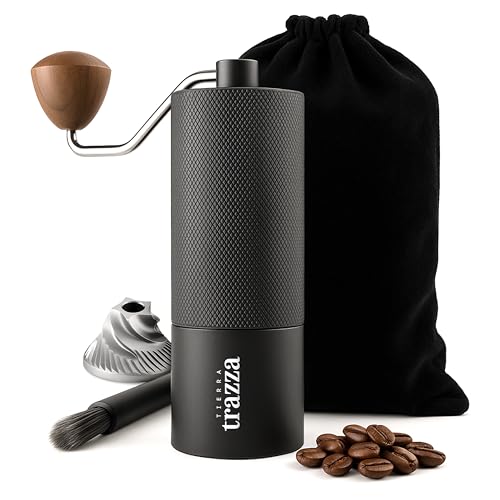
Best for: Quiet, portable manual coffee brewing
The Tierra Trazza is a manual conical burr grinder for espresso, French press, travel, camping, and home use. It uses stainless steel burrs to break beans into a more even grind than basic blade grinders. A precision-machined core supports the burr assembly, while the aluminum-alloy body gives the grinder a stable frame. The real walnut handle adds a warmer touch than an all-metal design.
Its diamond-pattern grip should make turning easier and more secure, especially during longer grinding sessions. The grinder needs no outlet, battery, or motor, so it produces very little noise and works at an office desk or campsite. Its compact body fits inside the included velvet pouch for transport. Around $47, it offers a more substantial build than many entry-level hand grinders, but the available details do not list the grinder’s capacity or the number of grind settings. That makes it harder to judge how well it fits larger batches or precise espresso dialing.
Pros
- Stainless steel conical burrs support a more consistent grind than blade-style grinders.
- Aluminum alloy and a walnut handle provide a sturdy, comfortable build.
- Cord-free operation and the included velvet pouch suit travel, camping, and office use.
Cons
- Manual grinding takes physical effort and time, especially for several cups.
- The product details do not state its bean capacity or grind-setting count, which limits buying confidence.
1. CEVING Mini Manual Coffee Grinder

Best for: Travelers brewing single-cup coffee
The CEVING Mini Manual Coffee Grinder is a compact hand grinder for fresh coffee at home, work, camping, or in an RV. It weighs 325 grams and measures 6.7 by 2.3 by 7.4 inches, so it takes up little space in a travel bag. Its 30-gram bean chamber can cover one large brew or several smaller cups, but it is not designed for batch grinding.
What sets this model apart is the external adjustment ring. You get 40 grind settings without taking apart the grinder, with options for espresso, pour-over, French press, and other brewing methods. The conical ceramic burrs are designed to produce a more even grind while creating less heat than steel or blade designs. At around $18, it offers useful control at a low price. The grinder has three main parts, including the lid, and comes with a brush and user guide. Cleaning should stay dry, since the instructions advise against using water.
Pros
- 40 external settings make grind changes quick and accessible.
- Ceramic conical burrs create a more consistent grind with less heat.
- 325-gram portable body fits travel, office, patio, and camping use.
Cons
- Manual grinding takes more time and effort than using an electric grinder.
- The 30-gram capacity is limited for households making several cups at once.
Buying Guide
The most important factor is grind consistency. A reliable burr mechanism produces even particles, which helps pour-over, French press, and AeroPress coffee taste balanced without batteries or an outlet.
- Burr material: Choose stainless-steel or ceramic burrs. Stainless steel usually handles drops better, while ceramic resists heat and corrosion.
- Grind adjustment: Look for at least 20 settings, or a stepless adjustment system. A range from fine espresso to coarse French press gives more brewing options.
- Packed size and weight: Keep the grinder under 8 inches long and 2 pounds if you carry it in a backpack. A removable handle can save space.
- Bean capacity: A 25- to 35-gram chamber covers two 12-ounce cups. A smaller 15-gram chamber suits solo campers and reduces pack weight.
- Construction and maintenance: Pick aluminum or reinforced polymer around the body, with a secure lid and accessible burrs. Tool-free cleaning is useful outdoors, and replacement parts should be available.
If you cannot have everything, prioritize consistent burr performance, then accept a smaller capacity or slightly heavier body.
Frequently Asked Questions
How do you choose a coffee grinder for camping?
Choose a camping coffee grinder by comparing grind consistency, weight, durability, and how much coffee it holds. For most trips, a hand grinder under 1 pound with a 20-30 gram capacity balances portability and enough coffee for two daily cups of coffee.
What makes a hand coffee mill good for camping?
A good camping hand grinder is compact, durable, easy to adjust, and comfortable to use without electricity. Look for stainless steel or reinforced plastic parts, a folding or removable handle, and a grind range that covers fine through coarse settings.
Can I use a manual coffee grinder for camping?
Yes, you can use a manual coffee grinder for camping as long as it fits your beans, brewing method, and available packing space. A 20-gram capacity suits one large mug, while a 30-gram chamber can cover two smaller pours without refilling.
Are electric grinders practical for camping?
Electric grinders are practical at campsites with reliable power, but manual models work better for remote trips. Battery units may need spare cells or charging, while a hand mill requires only beans and usually takes about one to two minutes per serving.
Conclusion
CEVING Mini Manual Coffee Grinder is the top pick for campers who want a compact, simple grinder for one or two fresh cups, especially backpackers and travelers with limited space. If your priority is serving several people, choose a larger-capacity manual grinder instead, since its bigger hopper can reduce repeated loading and speed up camp mornings. Before buying, double-check the packed size, compatibility with your preferred beans and brewing method, grind quantity per load, and current price, since these details affect storage, daily use, and overall value. A small grinder saves room, but limited capacity may become frustrating when everyone wants coffee. The right choice depends on how much coffee you make and carry.

