
The EUHOMY 53QT Portable Refrigerator is the best camping fridge for most buyers because its 53-quart capacity gives families and groups useful room for food and drinks. Its portable chest design suits car campers, road trips, tailgating, and longer stays at campsites.
This guide is for shoppers who need cold storage away from a kitchen, but do not want to rely on ice. The most important factors are interior capacity, outside dimensions, power options, and battery performance. A larger cooler holds more supplies, yet it also takes more space in a vehicle and may use more power. The five picks below are ranked by their practical strengths, with clear reasons and honest drawbacks for each. You will find options for family trips, compact setups, and campers who need freezer space.
Quick Comparison
| # | Product | Best For | Price | |
|---|---|---|---|---|
| 1 | EUHOMY 53QT Portable Refrigerator | Large-Capacity Road Trip Storage | ~$213 | View → |
| 2 | Feelfunn 12V Portable Refrigerator | Compact Car Camping Cooling | ~$160 | View → |
| 3 | BougeRV 23-Quart Portable Refrigerator | Small RV Food Storage | ~$152 | View → |
| 4 | EUHOMY 12 Volt Refrigerator | Everyday Vehicle Meal Cooling | ~$135 | View → |
| 5 | EUHOMY 48QT Portable Refrigerator | Family Camping Food Storage | ~$230 | View → |
5 Camping Fridges Worth Considering
The list is ranked by cooling performance, capacity, power options, and portability, counting down to the top pick.
5. EUHOMY 48QT Portable Refrigerator
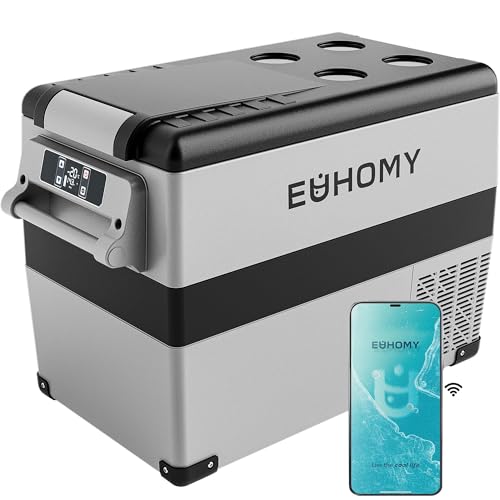
Best for: Road trips and weekend camping
The EUHOMY 48QT portable refrigerator is a compressor-powered cooler for vehicles, campsites, RVs, and home use. Its temperature range runs from -4°F to 68°F, so it can chill drinks or store frozen food. The listed capacity fits up to 46 standard 12-ounce soda cans, with extra room for meals and snacks. A removable basket helps separate smaller items from larger containers.
The fridge can cool from 68°F to 32°F in about 15 minutes under the stated conditions. Its 45-watt average power use is reasonable for a 12-volt appliance, while ECO and MAX modes let you favor battery savings or faster cooling. Three battery-protection levels help reduce the chance of draining a vehicle battery. It includes 12/24-volt DC and 110/240-volt AC adapters, plus an LCD control panel and app access. A built-in light helps at night, and the handle makes moving the unit easier. Around $230, it costs more than a basic ice chest but adds active cooling without ice.
Pros
- 48QT capacity holds up to 46 12-ounce cans, along with food and frozen items.
- Dual DC and AC adapters support vehicles, RVs, campsites, and home use.
- ECO mode, 45-watt average consumption, and three battery safeguards suit longer trips.
Cons
- The 48QT body takes substantial cargo space, which may be difficult in smaller cars.
- It needs a powered connection to cool, so it cannot replace an ice chest during an outage or away from outlets.
4. EUHOMY 12 Volt Refrigerator

Best for: Road trips with frozen food
The EUHOMY 19-quart electric cooler works as either a refrigerator or freezer. Its temperature range runs from 68°F down to -4°F, giving it enough range for drinks, groceries, and frozen items. It includes 100/240V AC and 12/24V DC adapters, so you can use it at home, in a vehicle, or at a campsite. The listed price is around $135, though it may change.
A compressor rated at 45 watts can cool from 77°F to 32°F in about 15 minutes, according to the manufacturer. Bluetooth app control lets you adjust settings from a phone. The lid uses a magnetic seal with a rubber gasket, which helps limit warm air entering the compartment. Three battery-protection levels, labeled L, M, and H, help reduce the risk of draining a vehicle battery. EUHOMY also lists 42-decibel operation, anti-shock construction for inclines up to 30 degrees, and two years of technical support.
Pros
- 19-quart capacity fits food and drinks for short trips.
- AC and DC adapters support home and vehicle use.
- Three battery-protection settings help protect car batteries.
Cons
- A 19-quart compartment may feel small for group travel or extended camping.
- App control depends on Bluetooth and may be less useful when the phone is out of range.
3. BougeRV 23-Quart Portable Refrigerator
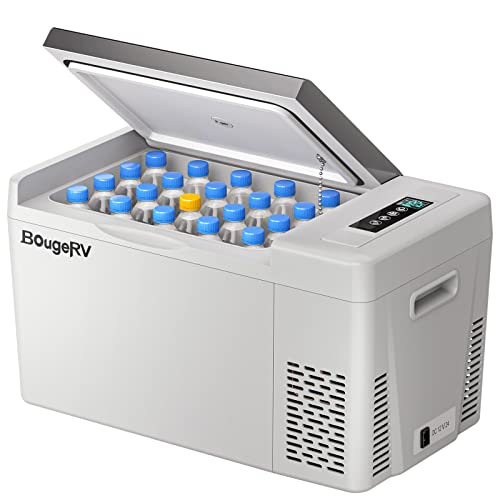
Best for: Car campers needing frozen food
The BougeRV CR22 is a 23-quart portable refrigerator/freezer for vehicles, RVs, boats, and off-road trips. Its compressor system can cool from 77°F to 32°F in about 15 minutes, or reach -5°F in roughly 50 minutes. The listed temperature range extends from -8°F to 50°F, so it can hold frozen items or chilled drinks without ice. At 22.68 by 12.60 by 12.97 inches and 22.27 pounds, it fits better in many cargo areas than larger chest-style units, though the 23-quart capacity remains modest.
Power comes through 12V or 24V DC, with included DC and 6.56-foot AC cords. ECO mode uses under 45 watts while running, and MAX mode reaches 60 watts. The compressor cycles rather than drawing its full rating continuously, according to the product details. A three-level battery monitor lets you choose a shutoff point. Noise is rated at 45dB, and the shock-resistant design is intended to operate on inclines up to 30 degrees. BougeRV includes two years of tech support. Keep it out of direct sunlight, which can deform the door.
Pros
- Cools to 32°F in about 15 minutes.
- Uses under 45 watts in ECO mode.
- Three battery-protection levels help prevent full drain.
Cons
- The 23-quart capacity may feel small for extended trips.
- Direct sunlight can deform the refrigerator door.
2. Feelfunn 12V Portable Refrigerator
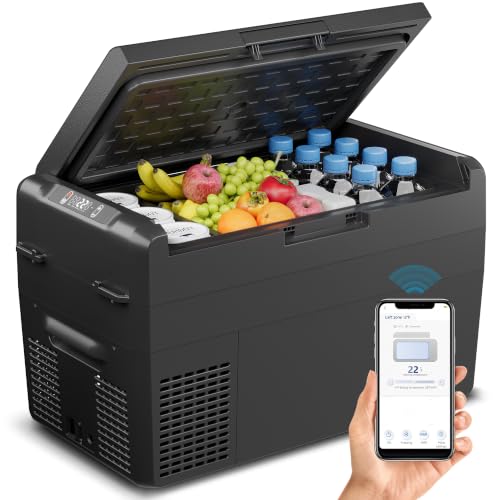
Best for: road trips and campsite food storage
The Feelfunn is a 27-quart portable refrigerator and freezer for cars, campsites, and emergency backup. Its 12V system can cool from 77°F to 32°F in a claimed 15 minutes, then reach -4°F in about 45 minutes. AC and DC adapters are included, so it can work from a vehicle outlet or household power. At around $160, it costs more than a basic ice chest but adds powered cooling without loose ice.
Several details make this cooler more useful on longer trips. A phone app lets you change the temperature, select refrigerator or freezer mode, and check battery status from nearby. ECO mode uses 28W, or less than 1 kWh per day according to the listing. Feelfunn also claims up to 50 hours of cold retention with the included ice pack and insulation. Four anti-shake anchor points support use on slopes up to 40 degrees. Its 45dB operating noise should be manageable near a tent, though actual cooling times and battery life depend on starting temperature, ventilation, and power access.
Pros
- Reaches refrigerator temperature in a claimed 15 minutes.
- App control includes temperature, mode, and battery monitoring.
- Three-level battery protection helps limit vehicle battery drain.
Cons
- A 27-quart interior may feel small for large groups or extended trips.
- The fastest cooling and 50-hour claim depend on conditions and available power.
1. EUHOMY 53QT Portable Refrigerator

Best for: Long road trips and RV travel
The EUHOMY 53-quart portable refrigerator uses a compressor to cool food and drinks in a car, camper, or home. It can drop from 68°F to 32°F in as little as 15 minutes, then hold temperatures from -4°F to 68°F. MAX mode cools faster, while ECO mode reduces power use. Around $213, it costs more than a basic ice cooler but adds true freezer capability.
Inside, two removable baskets and a detachable divider help separate meat, drinks, fruit, and snacks. The included 110/240V AC and 12/24V DC adapters support home and vehicle use. Three battery-protection levels help reduce the risk of draining a car battery. The LCD panel keeps temperature changes simple, and the unit can keep cooling on slopes up to 30 degrees. Off-road wheels and a pull handle make the large cabinet easier to move, while the 45 dB rating keeps compressor noise moderate.
Pros
- Reaches 32°F from 68°F in as little as 15 minutes.
- 53-quart capacity holds food, drinks, and frozen items for group trips.
- AC and DC adapters support home, RV, and vehicle power.
Cons
- The 53-quart size takes substantial cargo space in smaller cars.
- A 45 dB compressor is quieter than many appliances, but still audible at night.
Buying Guide
The most important factor is power efficiency, because a cooler that drains your battery can spoil food and leave you without lights. Compare its average 12-volt draw with your battery capacity and trip length.
- Power use: Choose a model with a published average draw, ideally under 1.5 amps per hour in moderate conditions. A 50Ah battery may provide roughly 20 to 30 hours after accounting for other devices and battery limits.
- Storage capacity: Allow about 5 to 8 liters per person for a weekend. A 25-liter unit suits one or two people, while groups of four may need 45 to 60 liters.
- Cooling range: For chilled food, look for settings near 34 to 40°F. If you need frozen meals, select a unit that reaches 0°F or lower.
- Size and transport: Check the outside dimensions before buying. A 30-liter cooler often measures about 24 by 14 by 16 inches, and wheels or sturdy handles help with loads above 35 pounds.
- Power and durability: Confirm 12V DC compatibility, plus 120V AC support for campsites or home use. A price between $250 and $700 is common for compressor models with insulated walls and digital controls.
If you cannot have everything, prioritize low power use over extra capacity or premium controls.
Frequently Asked Questions
How big of a camping fridge do I need?
Choose a camping refrigerator based on your group size, trip length, and available vehicle space. For one or two people, a 35- to 45-liter model usually covers several days of food and drinks without taking excessive cargo room. Families may need 50 to 65 liters.
What temperature should a portable fridge reach?
A portable camping fridge should reach about 0°F to 40°F (-18°C to 4°C) for safe, flexible food storage. A freezer-capable dual-zone unit can keep frozen meat near 0°F while holding drinks around 35°F in the other compartment. Check the manufacturer’s stated range, since some coolers only chill and cannot freeze.
Can a camping cooler run from a car battery?
Yes, most 12-volt camping refrigerators can run from a vehicle outlet, but battery protection matters. A 40-liter compressor model may draw roughly 1 to 3 amps after reaching temperature, while startup demand can be higher. Use a low-voltage cutoff or auxiliary battery for overnight parking.
Are compressor or thermoelectric coolers better for camping?
Compressor coolers are usually better for multi-day camping because they cool below ambient temperatures and can freeze food. Thermoelectric units are lighter and cheaper, but often cool only about 20°F to 40°F below surrounding air. Choose a compressor model for warm weather or frozen storage.
Conclusion
The EUHOMY 53QT Portable Refrigerator is the top pick for campers who need generous food storage, flexible power options, and room for longer trips. If low weight or a smaller footprint matters more, choose a compact 12- to 30-quart cooler instead, especially for solo travel, day trips, or limited vehicle space. Before buying, double-check the unit’s outside dimensions, power compatibility with your vehicle or battery setup, interior capacity for the quantity of food you carry, and its current price, then confirm that baskets and compressor hardware will not reduce usable room below what your trip requires, while checking the outlet type and cable length before relying on a vehicle socket at camp.

