
The Dr Infrared Heater DR-968 Portable Space Heater is the best heater for rv basement for most buyers because its 1,500-watt output and adjustable thermostat provide steady heat in a compact cabinet. This electric infrared heater also includes multiple heat settings, a remote control, and automatic safety shutoff features. Its portable design makes it easier to move between an RV basement, garage, or living area when needed.
This guide is for RV owners who need practical electric heat in a storage bay or nearby cabin space. The key factors are physical size, power draw, thermostat control, and safety features such as tip-over and overheat protection. You should also check available outlets and ventilation before choosing a model. The 6 picks below are ranked with clear reasons and honest drawbacks for each, so you can match the heater to your RV’s layout and power limits.
Quick Comparison
| # | Product | Best For | Price | |
|---|---|---|---|---|
| 1 | Dr Infrared Heater DR-968 Portable Space Heater | Portable Room Heating On Demand | ~$113 | View → |
| 2 | Xtreme Heaters Portable Space Heater | Simple Spot Heating Anywhere | ~$129 | View → |
| 3 | Heat Storm HS-1500-PHX-WIFI Wall-Mounted Infrared Heater | Wi-Fi Controlled Wall Heating | ~$150 | View → |
| 4 | POXURIO 9L Diesel Air Heater | Diesel-Powered RV And Camper Heating | ~$150 | View → |
| 5 | Boat Engine Compartment Heater, Marine Bilge Heater | Boat Engine Compartment Freeze Protection | ~$369 | View → |
| 6 | DREO Smart Electric Wall Heater | Smart Permanent Room Heating | ~$120 | View → |
6 Top RV Basement Heaters
This ranked list compares six RV basement heaters, counting down from practical options to the top pick.
6. DREO Smart Electric Wall Heater

Best for: Small bathrooms needing wall heat
This wall-mounted electric heater uses a PTC heating system and directed airflow to warm indoor spaces. A 30-degree adjustment range, 15 degrees up or down, lets you aim heat where it is needed. The unit suits bathrooms, bedrooms, RVs, and other compact areas. Its 70.8-inch power cord gives some placement flexibility, though the outlet still needs to be nearby.
Controls include a touch panel, remote, DREO app, and Alexa voice commands. Three modes include ECO, while the thermostat adjusts from 41°F to 95°F. DREO claims temperature changes stay within 2°F. Safety features include an ALCI plug, overheat protection, 5VA flame-retardant materials, and an IP24 rating for protection from water splashes. Installation uses a drilling template and video instructions, but it still requires wall mounting. At around $120, it costs more than a basic portable heater.
Pros
- The 30-degree airflow adjustment helps direct warmth toward a sink, bed, or seating area.
- Alexa, app, remote, and touch controls offer several ways to change settings.
- The ALCI plug, overheat protection, and IP24 rating suit bathroom use when installed correctly.
Cons
- Wall installation requires drilling, and the 70.8-inch cord may not reach every outlet.
- The listed details do not provide a wattage rating or recommended room size, making coverage harder to judge.
5. Boat Engine Compartment Heater, Marine Bilge Heater

Best for: Boats stored in freezing weather
This 400-watt bilge heater protects boat engine compartments during winter storage. It also suits RV underbellies, campers, well houses, greenhouses, and enclosed boat cabins. The unit is about 10% smaller than the previous design, yet adds 150 watts of heating power. A self-regulating PTC element turns on at 40°F and shuts off at 55°F, so it does not run continuously in cold conditions.
The anodized case, sealed electronics module, and waterproof 58 CFM fan support use in damp, enclosed spaces. You can mount the heater in any direction, including upside down. Its tricolored LED helps with basic status checks, while the unit carries Coast Guard, ABYC, and MILSPEC certifications for heat, moisture, cold, and vibration. The package includes a 15-foot marine-rated 110V cord with a three-prong plug. Around $369, it costs more than basic space heaters, but includes a five-year manufacturer warranty.
Pros
- Automatic 40°F to 55°F cycling limits unnecessary heating.
- Waterproof fan and sealed electronics suit damp engine compartments.
- Fifteen-foot cord gives more mounting flexibility around a boat or RV.
Cons
- It requires a dependable 110V power source, so it cannot protect an unplugged boat or remote structure.
- A 400-watt heater can add noticeable electricity use during long storage periods.
4. POXURIO 9L Diesel Air Heater

Best for: RV owners needing portable heat
The POXURIO 9L is a portable diesel air heater for RVs, trucks, campers, workshops, and boats. It has an 8KW heat rating and a stated coverage range of 215 to 269 square feet. The main unit includes a 9-liter, 2.38-gallon fuel tank, LCD controller, and remote. Its rated input is 12V, but the kit also supports 24V and includes a 100-125V adapter for standard 110V outlets. That flexibility avoids buying a separate power converter.
Fuel use is listed at 0.16 to 0.62 liters per hour, so the tank may provide up to 24 hours under favorable settings. The manufacturer lists operation from -45°F to 109°F and a remote range of 100 feet. The low-noise pump may suit overnight use, while the internal thread and rubber ring aim to reduce fuel leaks. Around $150, it includes useful accessories for the price. Still, setup requires careful exhaust routing and fuel handling.
Pros
- The 9-liter tank can support up to 24 hours of heating.
- The included adapter allows use with 110V outlets.
- LCD controls and a 100-foot remote simplify operation.
Cons
- Diesel exhaust must be routed outside, so this is not a plug-in indoor heater.
- The 8KW output may produce too much heat for small cabins or vehicles.
3. Heat Storm HS-1500-PHX-WIFI Wall-Mounted Infrared Heater

Best for: Small rooms needing wall-mounted zone heat
The Heat Storm HS-1500-PHX-WIFI is a 1,500-watt infrared wall heater for bedrooms, kitchens, offices, and other indoor spaces. It delivers 5,200 BTU and can heat up to 150 square feet as a primary source in a well-insulated room. As supplemental heat, its range can reach 750 square feet, depending on insulation. At around $150, it costs more than basic portable heaters, but the wall-mounted design keeps floor space open.
Wi-Fi control lets you adjust the temperature from a phone. A touch display, digital thermostat, and included remote provide other control options. The grille and heater stay cool to the touch, while the wall also remains cool. Installation over an outlet can hide the power cord inside the unit for a cleaner appearance. A tip-over safety shutoff adds protection, although this model is designed for wall installation and does not include feet.
Pros
- Wall mounting saves floor space in compact rooms.
- Phone control, a remote, and touch controls offer flexible temperature adjustment.
- 1,500 watts provide focused heat for rooms up to 150 square feet as a primary source.
Cons
- Feet are not included, so it cannot be used as a freestanding heater.
- The 150-square-foot primary heating range depends on good insulation, limiting its usefulness in larger or drafty rooms.
2. Xtreme Heaters Portable Space Heater

Best for: Small cabins, boats, and RVs
The Xtreme Heaters Portable Boat Cabin RV Space Heater is a compact electric warmer for small indoor spaces. It offers two heat settings, 750 watts for lighter heating and 1,500 watts for faster warmth. A six-foot power cord gives you more placement flexibility around a cabin, RV, or boat berth. The price is around $129, though it can change over time.
Its top-mounted air intake lets the unit sit against a wall or on carpet, according to the product details. A low-profile design and stable base help reduce tipping risks. If the heater falls in any direction, the tip-over switch cuts power automatically. Automatic overheat protection adds another safety layer. The heater is also listed as tested and certified to the UL 1278 standard. Quiet operation should suit sleeping areas and compact living spaces, though the product information does not provide a decibel rating. The 1,500-watt setting may warm a small area quickly, while 750 watts can help maintain a milder temperature with lower power use.
Pros
- Two settings, 750 and 1,500 watts, suit different heating needs.
- Six-foot cord allows more flexible placement.
- Tip-over and overheat protection add important safety controls.
Cons
- The 1,500-watt setting can place a heavy load on a small electrical circuit.
- It is intended for small spaces, not large rooms or open floor plans.
1. Dr Infrared Heater DR-968 Portable Space Heater
Best for: Drafty bedrooms and large living rooms
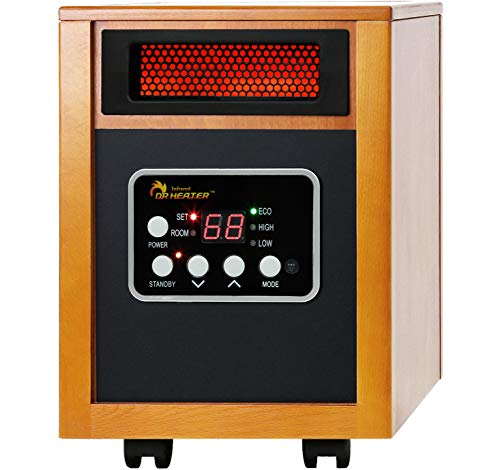
The Dr Infrared Heater DR-968 is a 1500-watt portable heater with a cherry-finish cabinet. Its dual heating setup combines an infrared quartz tube with a PTC heating element, and the listed output is about 5,200 BTU. High and low settings, plus an auto energy-saving mode, let you adjust heat use for changing room conditions. Around $113, it costs more than many small personal heaters.
A digital thermostat covers 50 to 85 degrees, while a 12-hour timer can shut the unit off automatically. The 39 dB blower should suit bedrooms, offices, and living areas where fan noise matters. An infrared remote handles basic controls from across the room. Caster wheels help move the 19-pound cabinet, and the 72-inch power cord offers useful placement flexibility. Tip-over and overheat protection add important safety features, though this heater still draws 12.5 amps on its highest setting.
Pros
- Dual quartz and PTC heating gives the unit about 5,200 BTU of listed output.
- The 39 dB blower keeps operating noise relatively low for sleeping or working.
- A 50-to-85-degree thermostat, remote, and 12-hour timer simplify room control.
Cons
- Its 12.5-amp draw can overload a shared household circuit with other high-power appliances.
- At 19 pounds, it is movable with casters but not easy to carry between floors.
Buying Guide
The most important factor is safe heat output matched to the compartment size and power source. An enclosed RV storage bay has limited airflow, so an electric unit with tip-over and overheat protection is usually safer than a fuel-burning model.
- Power source: Choose a 120-volt model only if the bay has a suitable outlet and circuit. A 500-watt unit draws about 4.2 amps, while a 1,500-watt model draws 12.5 amps.
- Heat output: Match wattage to the space. A small bay may need 500 to 750 watts to prevent freezing, while a larger compartment may need 1,000 to 1,500 watts.
- Safety controls: Require tip-over shutoff, overheat protection, and a thermostat. Look for ETL or UL certification, plus a grounded plug.
- Physical fit: Measure the compartment first. Leave at least 12 inches around the heater, and choose a unit under 10 inches tall if clearance is tight.
- Cold-weather operation: Pick a thermostat with a low setting near 40°F to 45°F. A 6-foot cord and splash-resistant housing can simplify placement, but keep water away from the unit.
If you cannot have everything, prioritize certified safety controls and correct electrical load over extra heat.
Frequently Asked Questions
What type of heater is best for an RV basement?
A low-wattage, thermostatically controlled heater is usually the best choice for an RV basement. Look for a compact ceramic or PTC unit with tip-over and overheat protection, then confirm it fits the compartment with space around air vents. A 200- to 400-watt model can provide gentle heat without demanding as much power as a 1,500-watt space heater.
How do you choose a heater for an RV storage bay?
Choose a basement warmer by matching its wattage, thermostat, safety features, and size to your RV. Prioritize a model with adjustable temperature control, tip-over shutoff, and overheat protection. For a small 20- to 40-square-foot bay, a 200- to 400-watt heater is often easier to power than a household 1,500-watt unit.
Can you leave an RV basement heater running unattended?
You can leave an RV basement heater running only when its manual permits unattended use and it has overheat and tip-over protection. Keep it on a level, nonflammable surface, leave air space around vents, and avoid extension cords unless the manufacturer approves them. Check the compartment after storms or power interruptions.
Are electric heaters safe for an RV basement?
Electric heaters are generally safer for an RV basement than open-flame heaters, but they still need clearance and proper electrical protection. Keep combustibles away from the intake and exhaust, and use a unit rated for the available voltage. A 12-volt model may draw about 17 to 34 amps at 200 to 400 watts, so verify circuit capacity before use.
Conclusion
Dr Infrared Heater DR-968 Portable Space Heater is the top pick for RV owners who want adjustable warmth, a remote, and a compact unit for an enclosed basement compartment. If your priority is lower power use or a smaller storage area, choose a low-wattage compact heater instead, provided it has suitable safety controls and clearance. Before buying, double-check the heater’s size, RV and outlet compatibility, quantity needed for each compartment, and current price. Also confirm that the space is approved for an electric heater and allows enough airflow around the unit. Keep cords away from moisture, flammable materials, and moving gear. A careful fit matters more than extra heating modes in this tight space.

