
For most buyers, the Spring Creek Manufacturing Canoe/Kayak Portage Cart is the best canoe cart for portaging because its adjustable frame fits a wide range of canoe and kayak hull sizes. Its aluminum construction keeps weight manageable, while pneumatic tires help it roll across gravel, grass, and uneven launch paths. That flexible fit makes it a practical choice for paddlers who own more than one boat.
This guide is for anyone moving a canoe from a vehicle to the water, across a campsite, or along a portage trail. Focus on rated load capacity, wheel diameter, frame material, and the cart’s attachment method. Larger wheels usually handle rough ground better, while a secure attachment reduces shifting during a carry. The 7 picks below are ranked with clear reasons and honest drawbacks for each.
Quick Comparison
| # | Product | Best For | Price | |
|---|---|---|---|---|
| 1 | Spring Creek Manufacturing Canoe/Kayak Portage Cart | Canoe Owners Needing Stable Transport | ~$395 | View → |
| 2 | Suspenz 22-9908 All-Terrain Kayak Cart | Rough Terrain Kayak Hauling | ~$200 | View → |
| 3 | Spring Creek Manufacturing Canoe/Kayak Portage Cart | Compact Boats With Heavy Loads | ~$340 | View → |
| 4 | Bonnlo Universal Kayak Carrier Trolley | Budget-Minded Recreational Paddlers | ~$58 | View → |
| 5 | GanFindX Kayak Cart | Quick Beach Launches | ~$88 | View → |
| 6 | VEVOR Kayak Cart | Adjustable Multi-Kayak Transport | ~$85 | View → |
| 7 | Wilderness Systems Heavy Duty Kayak Cart | Large Tandem Kayak Owners | ~$190 | View → |
7 Canoe Carts Worth Considering
This ranked list counts down from practical portage carts to the top pick, with weight, wheel design, and canoe fit guiding the order.
7. Wilderness Systems Heavy Duty Kayak Cart
Best for: Heavy kayaks and canoe launches
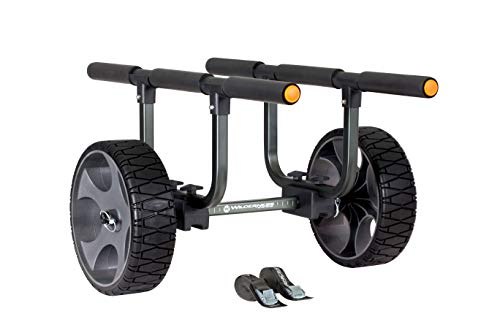
The Wilderness Systems Heavy Duty Kayak Cart is built for moving large kayaks and canoes from a vehicle to the water. It carries up to 450 pounds and uses flat-free wheels, so users do not need to maintain or inflate tires. At around $190, it costs more than basic kayak carts, but the higher weight rating suits fishing kayaks, tandem boats, and heavier touring models.
Its adjustable Bunker Bar frame helps keep the hull centered instead of sliding sideways. You can choose between two height settings. The higher position provides clearance for unusual hull shapes, while the lower setting keeps the load closer to the ground and may reduce tipping. Loading does not require a kickstand or scupper posts, which gives it wider compatibility across boat designs. The frame also folds down for storage in many kayak dry wells and other gear compartments. Paddling magazine named it a 2018 winner in its transport, storage, and launching category.
Pros
- Supports kayaks and canoes weighing up to 450 pounds.
- Adjustable width and two height settings fit different hull shapes.
- Flat-free wheels require no inflation or tube repairs.
Cons
- Around $190, it costs substantially more than simple carts.
- Without a kickstand, the cart may need support while positioning a heavy kayak.
6. VEVOR Kayak Cart

Best for: Kayakers moving heavy boats over mixed terrain
This VEVOR kayak cart is a compact carrier for kayaks, canoes, paddleboards, Jon boats, and similar gear. Its 2mm-thick aluminum alloy frame supports up to 450 pounds, giving it enough capacity for large recreational boats and loaded equipment. At around $85, it targets buyers who need more carrying strength than a basic beach cart.
The cart uses two 12-inch solid tires, so there is no inflation or pressure checking before a trip. Their large diameter helps roll over gravel, grass, and sand more easily than smaller wheels. A non-slip tie-down strap holds the boat against the padded support rod, while the adjustable frame fits widths from 170 to 440mm. The detachable design also makes storage and transport simpler. Its single-foot support lets you park the cart without laying it down, although uneven ground may still require careful loading.
Pros
- The 450-pound capacity suits heavy kayaks and loaded boats.
- Twelve-inch solid tires need no air and work across gravel, grass, and sand.
- The 170 to 440mm width range fits several boat and board styles.
Cons
- The 440mm maximum width may not fit very wide hulls or unusual boat shapes.
- Solid tires cannot be adjusted for softer rides, and they may transmit more vibration on hard, rough surfaces.
5. GanFindX Kayak Cart

Best for: Short hauls from car to shoreline
GanFindX’s heavy-duty kayak cart is a portable dolly for moving kayaks, fishing kayaks, canoes, and paddleboards over land. Its steel frame has a stated 300-pound capacity, while the adjustable support width is meant to accommodate different hull shapes. A tie-down strap helps hold the watercraft in place, and foam-covered support bars help reduce scratches and pressure marks on the hull.
The 16-inch wheels are the main practical advantage. They are flat-free, so there is no air pressure to check before a trip, and their larger diameter should handle grass, gravel, packed sand, boat ramps, and rough paths more easily than small cart wheels. The frame is designed to come off for storage in a vehicle, garage, or boat compartment. At around $88, it costs more than a basic small-wheel trolley, but the larger wheels and steel construction may suit heavier boats and longer walks. Buyers still need to confirm the hull width and stay within the 300-pound limit.
Pros
- 16-inch flat-free wheels suit grass, gravel, packed sand, and rough ground.
- Steel construction supports up to 300 pounds.
- Adjustable width, foam pads, and a tie-down strap accommodate varied hulls.
Cons
- The 300-pound capacity leaves limited margin for very heavy kayaks and added gear.
- The adjustable frame may not fit every hull shape or width securely.
4. Bonnlo Universal Kayak Carrier Trolley

Best for: Solo paddlers hauling boats
The Bonnlo Universal Kayak Carrier is a compact dolly for moving kayaks, canoes, paddleboards, float mats, and jon boats from a vehicle to the water. Its anodized aluminum frame uses 20-by-2-millimeter tubing and supports up to 200 pounds. Two 10-by-3-inch solid polyurethane tires avoid air-pressure checks and punctures. They should handle lawns, sand, and uneven ground better than small transport wheels.
The cart includes two 7.75-foot ratchet straps for securing a boat to the frame. Foam pads on the arms help protect the hull, while rubber foot bumpers reduce frame wear. A 12-inch spring-loaded stand keeps the trolley upright during loading, and the double kickstand adds support on shore. The frame folds for vehicle storage, and the wheels can come off for packing inside some kayak hatches. At around $58, it offers useful carrying capacity without reaching premium-cart pricing. Still, the 200-pound limit excludes many heavier boats once gear is added. A two-year warranty provides some coverage after purchase.
Pros
- Airless 10-inch tires cannot go flat and need no inflation.
- Folding frame and removable wheels make transport easier.
- Two included ratchet straps help hold the boat firmly.
Cons
- A 200-pound maximum leaves little margin for heavy boats and equipment.
- Solid tires provide less cushioning than pneumatic wheels over deep rocks or roots.
3. Spring Creek Manufacturing Canoe/Kayak Portage Cart

Best for: Canoe owners on smooth portage paths
The Spring Creek Canoe/Kayak Portage Cart is a compact carrier for moving one canoe or kayak by hand. Its aluminum and stainless steel frame keeps the cart light, while vinyl-covered supports help protect the hull. The cart supports loads up to 250 pounds and includes two 8-foot tie-down straps. Around $340, it sits in the premium range for a single-watercraft carrier.
Its 12-inch solid, flat-free wheels suit paved areas, packed trails, and other smooth surfaces. For rocks, roots, or softer ground, the optional 16-inch inflatable wheels make more sense, though they add tire maintenance. The bunk supports adjust along the 30-inch top bar, so you can set the spacing around different hull shapes. The wheels fold inward, and the handle works as a kickstand, which helps during loading and storage. The no-axle layout also leaves more clearance beneath the boat. For better balance, place the cart about one-third of the way from the canoe or kayak’s rear, then tow it while holding the front end.
Pros
- Aluminum and stainless steel construction resists corrosion and keeps the frame manageable to carry.
- Folding wheels and quick disassembly make storage easier in a vehicle or garage.
- Adjustable bunks and included 8-foot straps hold one boat securely.
Cons
- The 12-inch wheels are intended for smooth paths, not rugged trails or deep sand.
- A 250-pound limit allows one loaded canoe or kayak, but not multiple boats or heavy extra gear.
2. Suspenz 22-9908 All-Terrain Kayak Cart

Best for: Heavy kayaks on rough access paths
The Suspenz All-Terrain Kayak Cart Dolly is a steel boat trolley for kayaks, canoes, and multiple stand-up paddleboards. It supports up to 350 pounds and weighs 17 pounds itself. Its 15-inch airless wheels cannot go flat, which suits rocky trails, paved launches, and uneven ground. The frame folds to 31 by 16 by 9 inches for car or shed storage.
Its five-position bunker bars fit V-shaped, tunnel, catamaran, and flat-bottom hulls. The platform width adjusts from 9 to 20 inches, while the taller wheel clearance helps keep larger hulls off the ground. Four cam-buckle straps provide two strap sets and four-point restraint, and the foam-padded bars help protect the boat during transport. A spring-loaded kickstand supports solo loading. Around $200, this is a substantial cart for owners moving heavy boats often. The steel frame adds strength, but it can rust in harsh conditions, so a corrosion protectant such as Boeshield T-9 is a sensible extra.
Pros
- 350-pound capacity handles large kayaks, canoes, and multiple SUPs.
- 15-inch airless wheels avoid punctures and flat tires.
- Folding frame and included kickstand simplify loading and storage.
Cons
- At 17 pounds, it is heavier than many basic kayak carts.
- The steel frame can rust without regular rinsing and corrosion protection.
1. Spring Creek Manufacturing Canoe/Kayak Portage Cart

Best for: Rough-terrain canoe portage trips
The Spring Creek Manufacturing Portage Cart is a lightweight aluminum and stainless-steel carrier for one canoe or kayak. This version uses 16-inch inflatable wheels, which suit rougher paths better than the optional 12-inch solid, flat-free tires. Vinyl-covered supports protect the hull, while the adjustable bunks fit different boat widths along the 30-inch top bar. Its 250-pound load limit covers many recreational canoes and kayaks, but check your fully loaded weight before buying.
Several details make this cart practical for trail use. The no-axle design provides high ground clearance, and the wheels fold inward for compact storage. The handle doubles as a kickstand, so the cart can stay upright while you load the boat. It also includes two 8-foot tie-down straps. For better balance, position the cart about one-third of the way from the canoe or kayak’s rear, then tow it while holding the boat’s end. Around $395, it costs more than simple strap-on carriers, but the folding design and larger wheels add useful versatility.
Pros
- 16-inch inflatable wheels handle rougher paths better than smaller solid wheels.
- Aluminum and stainless-steel construction keeps the cart light and resists corrosion.
- Folding wheels, adjustable bunks, and a kickstand simplify transport and storage.
Cons
- The roughly $395 price is high compared with basic canoe carts.
- Inflatable tires can lose air or suffer punctures, unlike the optional 12-inch flat-free wheels.
Buying Guide
The most important factor is wheel performance on your usual portage trails. Large, wide tires roll more easily over roots, sand, and mud than small, narrow wheels.
-
Wheel size and tread: Choose tires at least 9 inches in diameter for packed paths. For sand, mud, or loose forest soil, look for 12- to 16-inch balloon-style tires with wide tread.
-
Load capacity: Match the cart to the canoe plus gear. A 65-pound canoe carrying 35 pounds of equipment needs at least a 125-pound rated cart, leaving a safety margin.
-
Attachment method: Strap-on models fit more canoe shapes but can shift on rough ground. A frame that cradles the hull and uses two adjustable straps offers better control during longer carries.
-
Frame and axle design: Aluminum keeps many carts near 10 to 20 pounds, while steel can handle heavier loads but weighs more. A removable axle or folding frame helps when storage space measures under 24 inches.
-
Portability and price: For frequent trips, choose a model that folds or breaks down without tools. Basic carts often cost $70 to $130, while larger balloon-wheel designs commonly reach $150 to $250.
If you cannot have everything, prioritize wheel size and terrain fit, since poor tires can make even a strong cart difficult to move.
Frequently Asked Questions
How do I choose a canoe cart for portaging?
A good portage cart should match your canoe’s weight, hull shape, and the terrain you will cross. Look for padded supports, a secure strap, wide wheels, and a frame that folds for transport. For rocky trails, pneumatic tires around 10 to 16 inches usually roll better than small hard wheels.
What type of wheels works best on canoe portage carts?
Pneumatic wheels are usually the best choice for sandy, muddy, or root-covered portage trails, while solid wheels suit pavement and short carries. Choose tires at least 10 inches in diameter. A pair of 12-inch pneumatic tires can spread weight better than narrow wheels, but they may need air checks and can puncture.
Can one canoe dolly carry a fully loaded boat?
Yes, one properly rated canoe dolly can carry a fully loaded boat if its weight limit exceeds the canoe, gear, and accessories combined. Add those weights before buying, then leave a safety margin. A cart rated for 150 pounds should not carry a 145-pound load on uneven ground.
Are folding canoe carts worth buying for long portages?
Folding canoe carts are worth buying when storage space and transport size matter more than maximum trail stability. They fit inside many canoes and vehicles, but folding joints add parts that need checking. A model that folds to roughly 24 inches can be easier to pack than a fixed-frame carrier.
Conclusion
Spring Creek Manufacturing Canoe/Kayak Portage Cart is the top recommendation for paddlers who want a sturdy, purpose-built carrier for regular canoe trips and longer carries. If your priority is lighter storage and easier packing, choose a compact folding cart instead, even if it may trade some load capacity or stability for a smaller folded size. Before buying, double-check the cart’s frame and wheel size, compatibility with your canoe’s hull, the quantity of straps or supports included, and the current price. A good match should fit your boat without forcing the hull into an awkward position. It should also be easy to lift, store, and secure between the water and your vehicle. That balance matters most on rough portage paths.

