
The Newport NV-Series 36lb Thrust Trolling Motor is the best canoe motor for most buyers, mainly because its 36 pounds of thrust offer useful push without the bulk of a larger outboard. Its electric design also suits quiet lake trips and protected waterways where a gas engine would be excessive.
This guide is for canoe owners who want a practical motor for fishing, camping, or longer flat-water outings. The key choices are motor weight, thrust, shaft length, and battery life, since a heavy unit can upset a small hull and a weak battery can end a trip early. The six picks below are ranked with clear reasons and honest drawbacks for each. You will find options for compact recreational canoes, wider fishing models, and paddlers who value longer run times over minimum weight.
Quick Comparison
| # | Product | Best For | Price | |
|---|---|---|---|---|
| 1 | Newport NV-Series 36lb Thrust Trolling Motor | Small Freshwater Fishing Boats | ~$170 | View → |
| 2 | Minn Kota Endura C2 Trolling Motor | Budget Kayak Anglers | ~$164 | View → |
| 3 | Newport NV-Series Saltwater Trolling Motor | Saltwater Flats Fishing | ~$240 | View → |
| 4 | 4 HP Short-Shaft Outboard Motor | Compact Transom Boats | ~$239 | View → |
| 5 | 65lb Electric Trolling Motor for Boats | Larger Electric-Powered Boats | ~$105 | View → |
| 6 | 48V Electric Jet Motor for Inflatable Boats | High-Voltage Inflatable Boat Owners | ~$185 | View → |
6 Top Canoe Motor Picks
These six canoe motors are ranked by power, control, portability, and value, counting down to the top pick.
6. 48V Electric Jet Motor for Inflatable Boats

Best for: Quiet fishing on small boats
This 48V electric jet motor is designed for inflatable kayaks, dinghies, canoes, and aluminum boats up to 13.12 feet long. Its 1,000W brushless motor spins at up to 3,700 RPM, while the jet pump sends water through the housing instead of using an exposed propeller. That design can reduce problems with weeds and fishing line. The motor weighs 22 pounds and clamps onto a transom without tools, making it easier to move between boats.
The listed top speed is 15 km/h, with up to 551 pounds of claimed thrust. A 30–120Ah 48V battery can provide roughly two to eight hours of operation, but the battery is not included and actual runtime depends on boat weight, speed, and water conditions. The aluminum alloy housing resists rust, and cooling vents help manage heat. Around $185, it costs less than many complete electric outboard setups, but you still need to budget for a suitable battery, charger, and secure mounting surface.
Pros
- Jet-pump drive avoids an exposed propeller that can catch weeds or line.
- 22-pound weight and tool-free clamp simplify transport and installation.
- A rotating tiller provides direct steering control for fishing and maneuvering.
Cons
- The 48V battery and charger are sold separately, adding significant cost.
- Claimed two-to-eight-hour runtime varies widely with load, speed, and battery capacity.
5. 65lb Electric Trolling Motor for Boats

Best for: Quiet fishing on small boats
This 12V electric trolling motor is rated at 660W and listed in the 65-pound thrust class, with the feature details specifying up to 66 pounds. It suits small boats, kayaks, and canoes up to 13.1 feet long and 1,322 pounds. The brushless pure-copper motor reaches about 6–8 km/h, depending on boat load, water conditions, and battery choice. Around $105, it costs far less than many full-size marine motors, though the battery and charger may add to the total.
Five forward speeds and two reverse speeds give you better control around docks, fishing spots, and shallow water. One-touch cruise control can reduce hand fatigue during longer outings. The handle extends for a more comfortable reach, while the motor tilts through 90 degrees to help clear underwater obstacles. Its stainless steel and plastic construction is designed for corrosion resistance, and the clamp fits transoms up to 3.54 inches thick. The listed 50-dB operation should create less noise than a gas motor, but speed and range still depend heavily on the battery.
Pros
- 5 forward and 2 reverse speeds support controlled maneuvering.
- 90-degree tilt helps avoid rocks, weeds, and shallow bottoms.
- Quiet electric operation produces no exhaust and less motor noise.
Cons
- Requires a separate suitable 12V battery, which adds weight and cost.
- The 6–8 km/h top speed is modest for stronger currents or larger boats.
4. 4 HP Short-Shaft Outboard Motor

Best for: Small boats on calm water
This compact outboard uses a 4.0-horsepower, four-stroke gasoline engine with a 60cc single-cylinder layout. Air cooling keeps the design simple and avoids a separate water-cooling system. Starting comes from a manual pull cord, while the hook-style handle helps with steering and reversing. Its short shaft suits many inflatable boats, canoes, dinghies, kayaks, and other small hulls. Confirm the boat’s transom height before ordering.
The motor runs on standard gasoline and is designed for freshwater or saltwater use, with a protective cowl over the engine. Adjustable motor angles can help trim the boat for different loads. The listing says it can move boats up to 1,000 kg and carry two or three people, though 4 hp will be most practical on light boats and calm water. At around $239, it costs less than many larger outboards, but its low power limits speed in wind, waves, or strong current.
Pros
- Four-stroke operation may use fuel more efficiently than a comparable two-stroke motor.
- The 60cc air-cooled engine avoids a water pump and cooling passages that need regular flushing.
- Short-shaft format and manual controls fit many small inflatable and flat-bottom boats.
Cons
- Four horsepower is limited for heavy boats, steep chop, strong current, or frequent three-person trips.
- Pull-start ignition requires physical effort, and this model lacks electric starting.
3. Newport NV-Series Saltwater Trolling Motor

Best for: Small saltwater fishing boats
The Newport NV-Series is a transom-mounted electric trolling motor for anglers who need steady control rather than high speed. Its 12-volt system produces 55 pounds of thrust, with five forward speeds and three reverse settings. The 30-inch shaft fits many small and medium boats, while the adjustable mount lets you change the motor’s angle, height, and direction. A 6-inch telescoping tiller gives the operator more control from the stern.
Several practical details make this motor appealing at around $240. A five-LED meter shows the battery level, and the three-blade propeller provides extra low-speed torque for getting a loaded boat moving. The motor is designed for quiet operation, which can help avoid disturbing fish. Its top speed is about 4 mph, though boat weight, hull shape, wind, and current can change that figure. Power comes from one 12-volt deep-cycle lead-acid or lithium battery. Newport recommends a 50Ah battery, but it is not included. A 50-amp circuit breaker is also included, while maximum draw reaches 52 amps.
Pros
- 55 pounds of thrust suits many small fishing boats.
- Five forward and three reverse speeds offer fine control.
- Five-LED battery meter provides a quick charge check.
Cons
- Battery purchase is separate, adding cost and setup time.
- About 4 mph limits this motor to trolling and short moves.
2. Minn Kota Endura C2 Trolling Motor
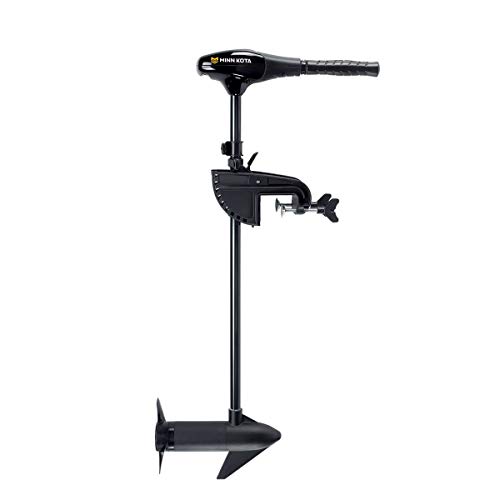
Best for: Small freshwater boats needing simple control
The Minn Kota Endura C2 is a transom-mount electric trolling motor for freshwater fishing. It delivers 30 pounds of thrust through a 30-inch composite shaft, a practical match for many smaller boats and calm-water setups. The six-inch telescoping tiller gives you more reach when the motor sits behind the seat, while the motor head includes a push-to-test battery meter. Power comes from a separate marine battery, so plan for that extra purchase if you do not already own one.
Its controls stay straightforward: five forward speeds and three reverse settings cover slow presentations, cruising, and short repositioning moves. A 10-position lever-lock bracket lets you change the motor angle without tools, and its reinforced composite construction resists flexing, warping, and sun damage. The Power Prop fits the 3 1/4-inch motor diameter and includes the pin, nut, and washer. It can push through heavier vegetation, although thick weeds may still reduce speed and runtime. At around $164, this is a basic freshwater tiller motor, not a GPS-equipped system.
Pros
- Six-inch telescoping tiller offers more comfortable reach and control.
- Five forward and three reverse speeds support precise adjustments.
- Composite shaft and bracket resist common marine wear.
Cons
- Freshwater-only design is not intended for saltwater use.
- The separate battery adds cost, weight, and setup time.
1. Newport NV-Series 36lb Thrust Trolling Motor
Best for: Lightweight kayaks and canoes
The Newport NV-Series is a 12V transom-mount trolling motor for kayaks, canoes, inflatables, and small boats. Its 36 pounds of thrust suit lighter craft, while the 30-inch shaft can work with many compact transoms. The motor uses a two-blade propeller and offers eight speed settings, including five forward and three reverse. Its quiet operation should help anglers move without adding much noise.
The corrosion-resistant construction supports freshwater and saltwater use, but saltwater users should still rinse the motor after each trip. An LED battery indicator gives you a quick view of remaining power. That feature can help with trip planning, especially when a small boat has limited room for spare gear. At around $170, this motor focuses on simple controls and low weight instead of high-output power. Newport provides California-based customer support Monday through Friday, from 9 a.m. to 5 p.m. Pacific time.
Pros
- 36 pounds of thrust fits kayaks, canoes, inflatables, and other lightweight craft.
- Five forward and three reverse speeds offer useful control around docks and shorelines.
- LED battery meter helps track power before returning to shore.
Cons
- The 36-pound rating may struggle against strong wind, current, or a heavily loaded boat.
- A 30-inch shaft may not reach well on deeper hulls or some higher transoms.
Buying Guide
The most important factor is thrust matched to your canoe’s total load. A motor that struggles with two people, camping gear, and current will move slowly and drain its battery faster.
- Thrust and load: Choose about 30 pounds of thrust for a light solo canoe, or 40 to 55 pounds for two adults, equipment, and moderate current. Check the maker’s maximum load rating.
- Power system: A 12-volt electric motor suits most recreational canoes. Select a 24-volt model only if you need longer run times or more thrust and can carry two batteries.
- Shaft length and mount: A 30-inch shaft fits many canoes, but measure from the mounting point to the waterline. Select a transom mount for a square stern, or a compatible bracket for a pointed canoe.
- Battery and runtime: Match the battery to the motor’s amp draw. A deep-cycle battery rated at 100 amp-hours can support several hours of moderate use, but confirm the manufacturer’s runtime estimate.
- Weight and controls: Keep the motor under 25 pounds if possible. A tiller gives simple steering, while a foot control or remote adds weight and cost.
If you cannot have everything, prioritize thrust that matches your fully loaded canoe.
Frequently Asked Questions
What is the best canoe motor for fishing?
For most fishing canoes, a 30-pound-thrust electric trolling motor offers the best balance of control, quiet operation, and easy transport. Choose a 12-volt model with a short shaft for a low-seat canoe. A 30- to 55-amp-hour battery can support several hours, depending on speed and water conditions.
How much thrust does a canoe motor need?
Most solo canoes need 30 to 40 pounds of thrust, while loaded or tandem boats usually need 45 to 55 pounds. A 12-volt motor suits many small canoes, but strong wind, current, and extra gear may require more power. Avoid choosing a motor so large that it adds unnecessary weight.
Can you put a trolling motor on any canoe?
No, not every canoe can safely accept a trolling motor without a secure mounting point. The hull needs a compatible transom or side-mount bracket that resists twisting. Check the canoe’s weight capacity before adding the motor, battery, and passengers. A complete setup can add 40 pounds or more.
Are electric canoe motors better than gas models?
Electric canoe motors are better for most short trips because they run quietly, require less maintenance, and avoid fuel storage. A 12-volt setup works well on calm lakes and slow rivers, while gas motors suit longer outings where refueling matters. Electric models still need a charged battery and dry storage.
Conclusion
The Newport NV-Series 36lb Thrust Trolling Motor suits canoe owners who want controlled propulsion for calm lakes, fishing trips, and moderate loads. If your priority is stronger current performance or carrying heavier gear, choose a higher-thrust model with a mounting system your canoe supports. Before buying, double-check your canoe’s size and weight rating, motor compatibility, package quantity, and current price. Confirm the shaft length and battery requirements, too, since those details affect setup and runtime. This 36-pound-thrust class works well for relaxed exploring, but it may feel limited in strong wind, thick weeds, or moving water, so match the motor to your usual conditions.

